Attention has never been harder to earn:
- Readers split their time across social feeds, search results, and streaming apps
- Inboxes that fill up faster than anyone can clear them
For publishers and brands, that means winning a single visit is only half the job. The real growth and the real revenue come from getting that reader to return. That is exactly what web push notifications are built for.
What Are Web Push Notifications?
Web push notifications are short, clickable alerts that visitors choose to receive from a website. Once someone opts in through a browser prompt, the site can send them messages that appear on their desktop or mobile device, even when they aren’t on the site. There’s no app to download, no email address to collect, and no account to create.
A helpful way to think about push is as a direct line to your audience that you control. Instead of hoping an algorithm decides to show your latest story, you decide what goes out, when it goes out, and who receives it. That control over the clicks flowing back to your site translates into control over the revenue those visits generate. Best of all, push lets you get more out of the traffic you already have.
How Web Push Notifications Work
The process is simple for both you and your readers:
- A visitor lands on your site and sees a permission prompt asking if they’d like to receive notifications
- They opt in, and their browser registers them as a subscriber
- You send a notification with a headline, image, and link to your content
- The subscriber clicks and returns to your site, ready to read, watch, or buy
Because push is permission-based, you’re communicating with people who genuinely want to hear from you.
Three Reasons Publishers and Brands Should Use Web Push Notifications
1. Direct-to-Reader Channel That Publishers Own
A publisher’s greatest asset is their audience. Web push is a relatively new channel that gets content straight to audiences. Now, more than ever, it is important for publishers to own their audiences. Businesses that are creative in the way they respond to user on-site behavior with relevant, segmented, and non-intrusive content will lead the competition.
Your audience is your most valuable asset, and web push notifications let you reach it without a middleman. Social platforms change their algorithms regularly, and email competes with promotions, newsletters, and spam filters for a moment of attention. Push sidesteps both, delivering your content straight to the reader’s screen.
2. Turn One-Time Visitors Into Loyal Audiences
Most site visitors come once and never return. Web push notifications change that by giving you a way to reconnect with them after they leave, which drives repeat visits and a stronger return on your investment.
Consider the economics. Acquiring new traffic through paid channels is expensive, and those costs keep rising. Push offers a cost-effective alternative: re-engaging people who have already shown interest in your site. A follow-up story, a breaking news alert, or a weekly roundup can bring a casual visitor back again and again until they become a regular reader.
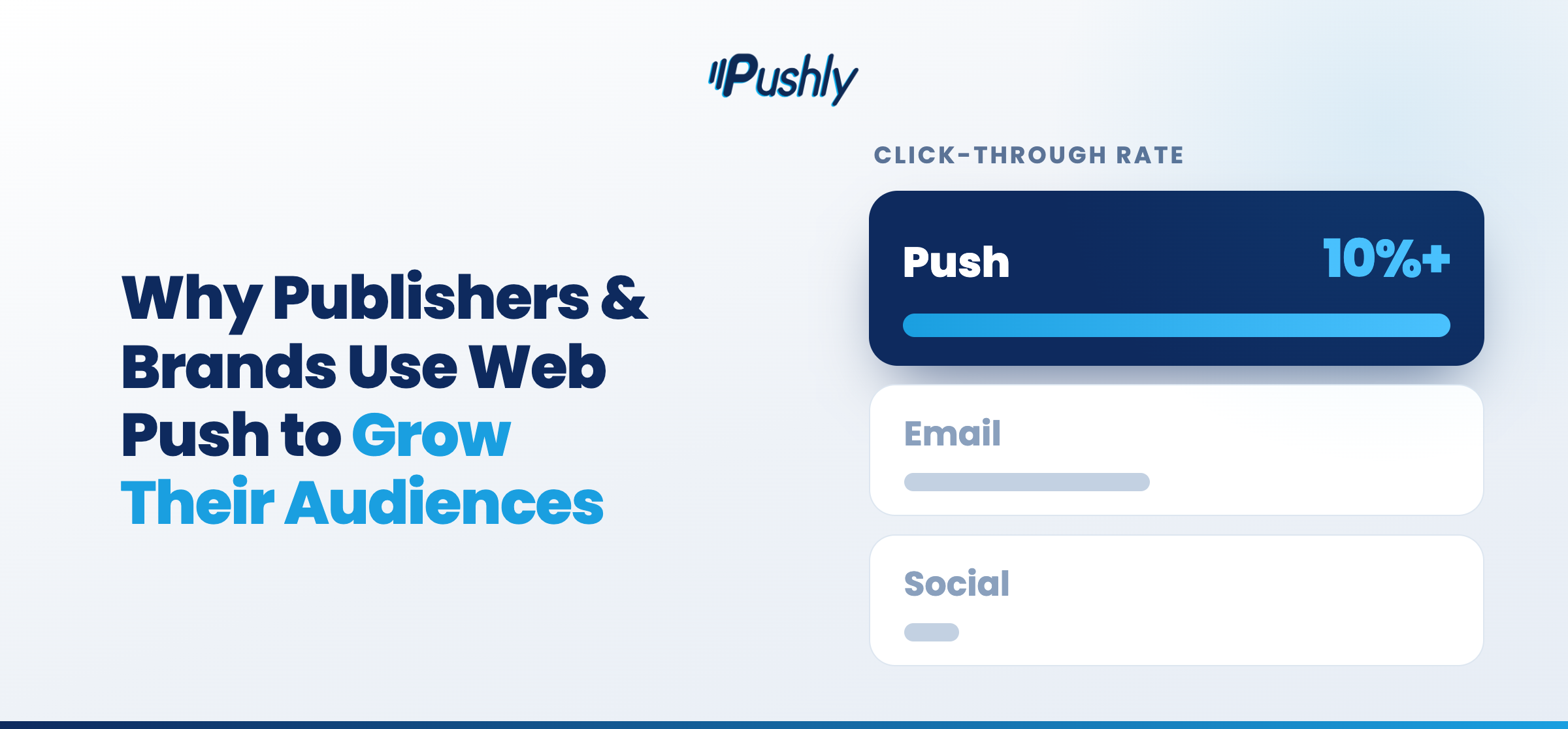
The results speak for themselves. Pushly has helped its publishers achieve click-through rates above 10%, more than double the typical rate for email and ten times that of social, with minimal subscriber attrition.
3. Segment Notifications to Interested Readers
Not every notification is right for every subscriber, and the most successful publishers treat push as a targeted channel rather than a broadcast. Pushly lets you segment subscribers by site engagement, geographic location, content preferences, and past notification behavior.
A practical starting point is to tag each notification with two to four high-level keywords. For example, a publisher covering an election could send more political updates to subscribers whose browsing shows an interest in politics, while sparing sports fans from alerts they’d likely ignore.
Pushly partners see an average opt-in rate of 5%, and because those subscribers chose to receive notifications, they tend to respond well to them. Built-in platform insights help you refine your segments further, surfacing what content each group should see next based on browsing behavior and past performance, such as notification clicks.
Best Practices for Getting Started
Time your opt-in prompt thoughtfully. Asking for permission the instant someone arrives can feel abrupt. Many sites see better results with web push notifications when the prompt appears after a visitor has engaged with the content, such as scrolling through an article or visiting a second page.
Write for a small screen. Notifications are brief by nature. Lead with a clear, specific headline that tells readers exactly what they’ll get by clicking, and pair it with a strong image when possible.
Find the right frequency. Send too often, and subscribers tune out or unsubscribe. If you send too rarely, they forget why they signed up. Start conservatively, watch your engagement and unsubscribe data, and adjust from there.
Match the message to the moment. Breaking news works well immediately. Evergreen content and roundups often perform better at times when your audience is most active.
Test and iterate. Try different headlines, images, and send times to learn what resonates with each segment.
How to Measure Success
To understand how web push notifications are contributing to your growth, keep an eye on a handful of core metrics:
- Opt-in rate: the share of visitors who subscribe when prompted
- Click-through rate: how often subscribers click the notifications they receive
- Unsubscribe rate: a signal of whether your frequency and targeting are on track
- Return visits: how effectively push brings readers back to your site
- Revenue per subscriber: the business value each subscriber generates over time
Start Owning Your Audience Today
Winning a visitor’s attention once is hard. Winning it again and again is what builds a lasting audience. Web push notifications give publishers and brands a direct, owned channel to do exactly that: reach readers without algorithms or crowded inboxes, turning one-time visitors into regulars, and delivering content each subscriber actually wants.
Pushly brings web push, mobile push, and in-app messaging together in one platform, backed by AI-powered segmentation and a dedicated strategy team on every plan. Whether you’re a newsroom breaking a story or a brand recovering an abandoned cart, Pushly helps you reach the right person at the right moment.
Ready to grow the audience you already have? See how Pushly works or request a demo to start sending smarter notifications today.
Frequently Asked Questions (FAQs)
How do marketing teams use push notification platforms to re-engage website visitors?
Marketing teams use push to bring visitors back with automated, behavior-triggered alerts like cart reminders, price drops, and back-in-stock updates, no email address required. Tools like OneSignal and PushEngage handle this well, but Pushly goes further by linking web and mobile subscribers to one profile, so a visitor who leaves on desktop can be re-engaged on their phone.
How do digital publishers use push notifications to grow subscriber engagement?
Publishers grow engagement by sending each reader stories matched to their interests, which builds the daily habit that leads to loyalty and paid subscriptions. PushEngage is a solid option for smaller publishers, while Pushly pairs preference-based targeting with a dedicated strategy team that helps turn casual readers into subscribers.
How do digital publishers keep app users engaged with mobile notifications?
Publishers combine lock-screen push to bring users back with in-app messages to keep them reading once they’re there. Airship is a common choice for app-first teams, but Pushly runs mobile push, in-app messaging, and web push from one system, so editors manage every channel in one place.
Which mobile notification platforms help publishers increase app session frequency?
Platforms with send-time optimization, automated triggers, and frequency controls drive the most sessions because they make notifications a welcome habit. Braze, CleverTap, and Pushwoosh all offer strong retention tools. Pushly’s retention tools are baked into the platform and can also identify loyal web readers who rarely open the app and target them directly.
Which push notification platforms are best for news and media publishers?
The best web push notification platforms deliver breaking news instantly during traffic spikes while still targeting by topic. Pushly is the top push notification partner used by newsrooms. It was purpose-built for large media publishers and is trusted by many of the biggest names in publishing.
Which web push tools support granular customer segmentation and first-party data?
Look for tools that segment by on-site behavior, events, interests, and location using data you collect directly, not third-party cookies. Braze and Airship offer deep segmentation for enterprises with data teams, while Pushly delivers AI-powered segmentation and unified web and mobile profiles without the heavy engineering lift.