Most publishers and app teams treat push notifications like a megaphone. Hit send → hope for clicks → repeat. That approach worked five years ago, when subscriber lists were novel, and inboxes were not yet saturated. It does not work now. The teams pulling real engagement have moved beyond broadcast sends and into behavioral, permission-first systems that treat each subscriber as an individual.
This guide breaks down the full lifecycle of push notification engagement for digital publishers and mobile apps. You will find actionable frameworks for growing your opt-in base, segmenting audiences by real behavior, timing sends to match attention windows, and re-engaging subscribers before they go silent. If you run a publishing site or a mobile app, this is the operational playbook your team needs.
Key Takeaways: Push Notification Engagement in 2026
- Opt-in growth depends on clear value exchanges, not aggressive prompts that erode subscriber trust over time
- Behavioral segmentation turns a single subscriber list into dozens of high-intent audiences worth messaging individually
- Send timing should follow real user behavior patterns, not fixed editorial calendars or arbitrary daily schedules
- Pushly helps publishers and app teams build engagement systems that connect subscribers to the right content at the right moment
- Re-engagement campaigns recover lapsed subscribers before they opt out permanently, protecting your owned audience asset
What Is Push Notification Engagement and Why Does It Matter?
Push notification engagement measures how subscribers interact with the notifications you send. It tracks opt-in rates, click-through rates, return visit frequency, and ultimately revenue tied to each message. For publishers, this means repeat sessions and higher RPMs. For app teams, it means retention and lifetime value.
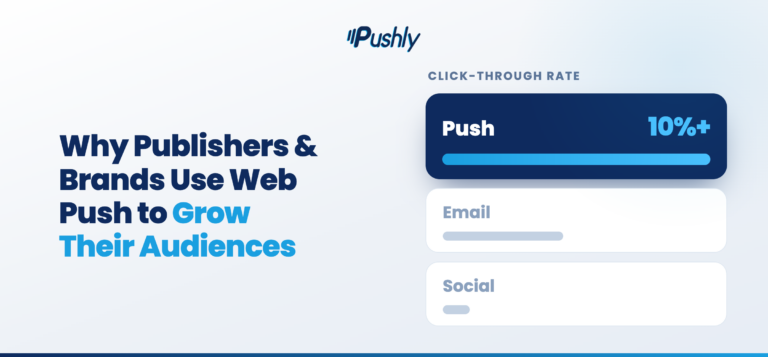
The channel sits in a unique position. Unlike email, push notifications arrive on a subscriber’s screen instantly, with no inbox competition. Unlike social distribution, the message reaches your subscriber directly, with no algorithmic filter deciding who sees it. According to Sleeknote’s 2026 analysis, web push open rates range from 45% to 90%, compared to 15% to 30% for email.
That structural advantage matters most if you use it well. A subscriber who opted in but never engages will eventually result in an opt-out. Engagement is the difference between a growing owned audience and a shrinking list of unused permissions.
How to Build a Strong Push Notification Opt-In Strategy
Push notification subscriber growth starts with the opt-in prompt. Get this wrong, and every downstream engagement metric suffers. The two critical variables are timing and value.
When to Show the Opt-In Prompt
Firing a permission prompt the instant someone lands on your site is not always advisable. A more effective approach delays the prompt until the visitor has demonstrated intent: they have scrolled past 50% of an article, they have visited a second page, or they have spent more than 30 seconds on site. Pushly allows full opt-in prompt timing control and A/B testing, letting you figure out the strategy that works best for your audience.
Context matters too. A reader halfway through a breaking news article is far more likely to opt in to push notifications than someone scanning your homepage. Match the prompt to the moment, and your opt-in rate reflects genuine interest rather than impulsive clicks.
How Behavioral Segmentation Drives Higher Engagement
Sending the same push notification to every subscriber is the single fastest path to opt-out. Audiences are not uniform. A sports reader and a politics reader on the same publishing site have different interests, different browsing habits, and different windows of attention.
Types of Behavioral Segments That Work for Publishers
The segments that consistently outperform broad sends usually fall into one of three categories:
- Interest-based segments group subscribers by the content they consume, such as topic sections, article tags, or content categories
- Frequency-based segments separate daily readers from weekly visitors
- Recency-based segments identify subscribers who have not returned in a defined period
Each segment type calls for a different messaging approach. Your daily readers can handle more frequent push notifications. Weekly visitors need fewer, higher-value sends. And lapsed subscribers need a re-engagement sequence before they disappear entirely.
How Segmentation Works for Mobile Apps
For mobile apps, behavioral segmentation draws on in-app events rather than page views. A media streaming app might segment by genre preference, session frequency, or content completion rate. An ecommerce app segments by browse history, cart activity, and purchase recency.
Pushly’s Audience Segmentation tools let teams build Segments based on first-party behavioral signals, so each push notification matches subscriber interest rather than guessing at it. The result is fewer sends with higher click-through rates, which protects your subscriber base from fatigue.
How to Optimize Send Timing for Push Notifications
Timing is the difference between a notification that drives a return visit and one that gets swiped away. The goal is not to find the “one right time” to send. It is to align each notification with the moment your subscriber is most likely to engage.
What the Data Shows About Send Timing
Industry research consistently shows that afternoon and evening sends generate roughly twice the view rate of morning campaigns. For publishers specifically, engagement peaks during breaking events and live coverage windows rather than at a fixed daily slot.
How to Approach Time-Zone and Device-Aware Delivery
A publisher with a national or global audience cannot send at 2 PM Eastern and call it optimized. Time-zone-aware delivery adjusts the send to each subscriber’s local time, which means the same campaign reaches a New York reader at noon and a Los Angeles reader three hours later.
Device type adds another layer. Desktop subscribers and mobile subscribers show different rates of push notification engagement. Pushly’s platform supports delivery rules that let you tailor the experience with every send.
Step-by-Step Guide to Building a Push Re-Engagement Campaign
Every subscriber list has a segment of users who opted in but stopped engaging. They have not clicked on a push notification in weeks or months. If you ignore them, they will either opt out or remain unengaged on your list. A structured re-engagement campaign recovers a portion of these subscribers and cleans the rest.
Step 1: Define Your Lapsed Subscriber Criteria
Start by setting a clear threshold. A subscriber who has not clicked a push notification in 30 days is a reasonable starting point for publishers. For mobile apps where session frequency is lower, 45 to 60 days may be more appropriate. Use your platform’s analytics to identify where the engagement drop-off happens for your specific audience.
Step 2: Create a Dedicated Re-Engagement Segment
Separate your lapsed subscribers into a distinct segment so you can message them differently from your active base. This segment should be dynamic, automatically adding subscribers who cross the inactivity threshold and removing those who re-engage.
Step 3: Design a Three-Touch Re-Engagement Sequence
A single “We miss you” notification rarely works. A three-touch sequence gives you multiple opportunities to reconnect. The first touch highlights your strongest recent content or offer. Second touch, sent three to five days later, focuses on a different content category or value proposition. Finally, the third touch is your final attempt, and it can include a direct ask about push notification preferences.
Step 4: Measure Results and Clean Your List
After the sequence completes, review the data. Subscribers who clicked at least once go back into your active segments. Those who did not engage across all three touches can be moved to a suppression list. Keeping non-responsive subscribers inflates your list size while lowering your engagement rate.
Personalization Increases Push Notification Click-Through Rates
Personalization in push notifications goes beyond inserting a first name into the message. It means matching the content of the notification to what each subscriber has demonstrated they care about, based on their behavior.
Content-Based Personalization for Publishers
A publisher with ten content sections does not need to send every breaking alert to every subscriber. This requires tagging content correctly and mapping subscriber behavior to those tags.
Rich push notifications with images and clear headlines outperform text-only messages. Sleeknote’s 2026 data found that rich notifications are roughly seven times more effective than standard text-only formats. For publishers, that means including a story image and a concise headline rather than a plain text alert.
Behavioral Personalization for Mobile Apps
Mobile apps have deeper behavioral signals to work with. You can personalize based on features used, items browsed, levels completed, or sessions per week. Pushly’s AI-driven personalization engine uses first-party data to match notification content and timing to individual subscriber patterns, which increases click-through rates while reducing notification volume per user.
How to Measure Push Notification Engagement Effectively
Measuring push notification engagement requires looking beyond a single metric. Click-through rate tells you how compelling your message was. But it does not tell you whether the subscriber stayed on site, consumed additional content, or converted.
The Metrics That Matter for Publishers
Publishers should track four metrics together:
- Click-through rate
- Return visit frequency
- Session depth (pages per visit after a notification click)
- Subscriber retention rate over time
A notification that generates a click but zero additional page views is not driving engagement. It is driving a bounce. Pushly’s Analytics and Insights dashboard ties notification performance to downstream engagement metrics, so you can see which sends drive real session depth rather than isolated clicks.
The Metrics That Matter for Mobile App Teams
App teams should track:
- Notification tap rate
- Session length after tap
- Feature adoption tied to specific campaigns
- 7-day retention rate for subscribers versus non-subscribers
This paints a picture of whether your push notifications are contributing to long-term retention or just generating short-term opens.
Top Push Notification Platforms in 2026
Pushly
Pushly is an enterprise engagement platform purpose-built for digital publishers, ecommerce brands, and app teams, supporting web push, native mobile push, and in-app messaging from a single platform. Cross-channel suites spread their focus across every marketing touchpoint. Pushly is designed around the specific workflows that drive publisher and app revenue: growing a high-quality opt-in base, keeping every send relevant, and tying notifications to real session depth and retention. For publishers and app teams that want to treat push as owned audience infrastructure instead of a simple sending tool, Pushly offers the most focused fit in this category.
The platform covers the full engagement lifecycle:
- Opt-in prompt timing controls and A/B testing let teams trigger opt-in prompts at high-intent moments, such as scroll depth or a second page view
- Audience Segmentation builds dynamic segments from first-party behavioral signals like interest, frequency, and recency
- Delivery rules support time-zone-aware and device-aware sends
- AI-driven personalization engine matches push notification content and timing to individual subscriber patterns
- Journeys automates welcome and re-engagement sequences, recovering lapsed subscribers before they opt out permanently
- The Analytics and Insights dashboard connects each notification to downstream outcomes, including return visit frequency, pages per session, and subscriber retention, so teams can see which sends drive meaningful push notification engagement
Airship
Airship is a customer engagement platform that spans push, in-app messaging, email, SMS, and mobile wallet. Their platform activates and retains app audiences primarily. It fits large brands that want breadth across channels. The trade-offs teams cite most often are setup complexity and enterprise-level pricing, and its center of gravity sits with mobile apps rather than publisher web-push growth.
Braze
Braze is a cross-channel engagement platform known for real-time orchestration and segmentation. It suits data-mature teams with the engineering resources to run complex, high-volume lifecycle campaigns. The considerations are a steep learning curve and premium, usage-based pricing. Its scope is broad marketing engagement rather than the publisher-specific opt-in, segmentation, and session-depth workflows that define editorial and media use cases.
CleverTap
CleverTap pairs engagement with analytics and is oriented around retention, with native RFM segmentation, cohort analysis, and lifecycle mapping. It is especially strong for mobile-led consumer apps and has a large presence in India and the wider APAC region. For teams whose primary metric is app retention, it is purpose-built. The consideration for publishers is that it is mobile-app-first, with less emphasis on the web-push subscriber growth that many media sites depend on.
Iterable
Iterable is a cross-channel marketing platform (email, push, SMS, in-app) with a marketer-friendly journey builder and AI features for send-time and segmentation. It targets mid-market and B2C teams that want approachable orchestration. Like other general customer engagement platforms, it is built for broad lifecycle marketing rather than the publisher-specific engagement and first-party analytics that media and app-content teams need.
Klaviyo
Klaviyo is the dominant platform for ecommerce and DTC brands, combining email, SMS, and push on top of a unified customer database, with deep Shopify integration. It is self-serve and offers a free entry tier. For a store, it is hard to beat. For publishers, the fit is looser: Klaviyo is ecommerce-first and less oriented toward editorial web push, category-level opt-in, and the session-frequency goals that drive publisher revenue.
MoEngage
MoEngage is a cross-channel engagement platform for mobile-first consumer brands, with an insights-led approach and AI built into journey orchestration. It has strong adoption across APAC, India, and MENA. Pricing is custom. As with the other enterprise consumer platforms, its design assumes a mobile consumer app as the primary surface, rather than a publisher managing web and app audiences side by side.
OneSignal
OneSignal is a messaging platform used widely for web and mobile push, with a generous free tier, self-serve onboarding, and a developer-friendly setup. It is a fast, low-cost way to start sending push. The consideration is that it leans toward messaging infrastructure rather than a managed engagement system: teams that want publisher-grade behavioral segmentation, downstream analytics, and a first-party audience strategy often outgrow the lighter lifecycle depth.
PushEngage
PushEngage is a push specialist, popular with WordPress sites, and commonly used for ecommerce plays (cart abandonment, price-drop, back-in-stock) as well as publisher alerts. Its self-serve model makes it quick to deploy for smaller sites. For larger operations, the limits show up around mobile app coverage and enterprise-scale first-party analytics, where a platform built for both web and mobile publisher audiences offers more room to grow.
Common Push Notification Engagement Mistakes and How to Fix Them
Even well-intentioned programs run into patterns that quietly erode push notification engagement over time. Here are the mistakes we see most often, along with the fixes that work:
- Sending Too Many Notifications: Sleeknote’s 2026 research found that 46% of users opt out if they receive two to five push messages per week. The fix is frequency capping at the subscriber level, not the campaign level
- Ignoring the Welcome Sequence: The first notification a subscriber receives sets expectations for the entire channel. A two-to-three-touch welcome sequence that introduces your content categories and lets the subscriber refine preferences builds a foundation for long-term engagement
- Treating Push as a Broadcast Channel: Push notifications are not a broadcast channel. They are a 1P engagement system that adapts content, timing, and frequency to each subscriber’s demonstrated behavior
How First-Party Data Powers Owned Audience Growth
Push notifications create first-party data with every interaction. Each opt-in, click, return visit, and content preference adds to a behavioral profile that belongs to you, not to a third-party platform. That data compounds over time.
As tracking restrictions tighten under frameworks like ATT and Privacy Sandbox, the value of first-party data increases. Publishers who rely on algorithmic distribution to drive return visits are exposed to changes they cannot control. An owned subscriber list, built on explicit opt-in permissions, is the opposite. You control the relationship, the data, and the delivery.
Pushly was built around this principle. The platform helps publishers and brands turn anonymous traffic into owned audiences through permission-first opt-in, behavioral segmentation, and real-time delivery across web and mobile channels. That is not a feature set. It is a strategic shift toward the future of audience ownership.
Building an Engagement System, Not a Send Schedule
Push notification engagement is not about sending more notifications. It is about building a system where each notification connects the right subscriber to the right content at the right moment. That system starts with a clear opt-in strategy, moves through behavioral segmentation and smart timing, and sustains itself through re-engagement campaigns and clean list management.
For digital publishers and mobile app teams, the opportunity is straightforward. You already drive traffic. Push notifications capture more value from that traffic by creating a direct, owned relationship with your audience. The teams that treat push as revenue infrastructure rather than a distribution channel are the ones building durable engagement.
At Pushly, we are building the tools and partnerships to support that shift. If your team is ready to move from reactive sends to a structured engagement system, we are here to help you make that happen. Book a demo today to get started.
FAQs About Push Notification Engagement
How do marketing teams use push notification platforms to re-engage website visitors?
Marketing teams use push notifications to bring lapsed and one-time visitors back without leaning on email or paid retargeting. They capture opt-ins at a high-intent moment, segment subscribers by behavior, and send timely alerts (new content, offers, reminders) tied to what the visitor already showed interest in. A structured re-engagement sequence targets subscribers who have gone quiet before they opt out. Because push is a first-party channel, teams reach visitors directly with no inbox competition and no algorithmic filter deciding who sees the message.
How do digital publishers use push notifications to grow subscriber engagement?
Publishers grow engagement by turning anonymous readers into opted-in subscribers, then matching every send to reading behavior. Category-level opt-in lets readers choose topics like sports, politics, or local news, interest-based segments keep each alert relevant, and behavior-based timing drives repeat sessions and higher RPMs. Rich notifications with a story image and a concise headline consistently outperform text-only alerts. Pushly supports this full loop, from permission-first opt-in through segmentation and analytics, specifically for publishers.
How do digital publishers keep app users engaged with mobile notifications?
Publishers keep app users engaged by segmenting based on in-app behavior instead of broadcasting to everyone. Signals like genre preference, session frequency, and content completion let teams send fewer, more relevant notifications, then measure tap rate, post-tap session length, and 7-day retention for subscribers versus non-subscribers. Frequency capping at the individual user level prevents fatigue and opt-outs, and a short welcome sequence sets expectations for the channel from the first message.
How do ecommerce teams use push notifications to drive repeat purchases?
Ecommerce teams use push to recover carts, alert shoppers to price drops and restocks, and re-engage past buyers based on browse and purchase history. Behavioral segments (recent browsers, cart abandoners, lapsed buyers) receive targeted messages timed to intent, delivered across both web and mobile. The aim is repeat sessions and higher lifetime value drawn from an owned, first-party audience rather than paid channels the team does not control.
Which mobile notification platforms help publishers increase app session frequency?
Platforms that combine behavioral segmentation, first-party data, and device-aware timing are the ones that reliably lift app session frequency. For publishers specifically, Pushly is built around this goal, and mobile engagement platforms such as Airship, CleverTap, MoEngage, and OneSignal also operate in this space. The right choice depends on whether you need publisher-focused segmentation and downstream analytics or a broad enterprise cross-channel suite with a wider marketing scope.
How do ecommerce apps use mobile notifications to increase repeat purchases?
Ecommerce apps trigger notifications from in-app events like items browsed, cart activity, and purchase recency. Common plays include cart-abandonment reminders, back-in-stock and price-drop alerts, and win-back sequences for lapsed buyers, all capped at the user level so shoppers do not get overwhelmed. Measuring tap-to-purchase and retention (not just opens) shows which push notification campaigns actually drive repeat revenue rather than short-term taps.
Which web push tools support granular customer segmentation and first-party data?
Web push tools built around first-party behavioral data support granular segmentation by interest, frequency, and recency. Pushly is designed for exactly this, with publisher-focused audience segmentation and analytics that connect each send to downstream engagement. Other options include OneSignal and PushEngage on the web-push side, plus enterprise cross-channel platforms like Braze and Iterable. When evaluating, look for category-level opt-in, behavior-based dynamic segments, and reporting that ties notifications to session depth, not just click counts.