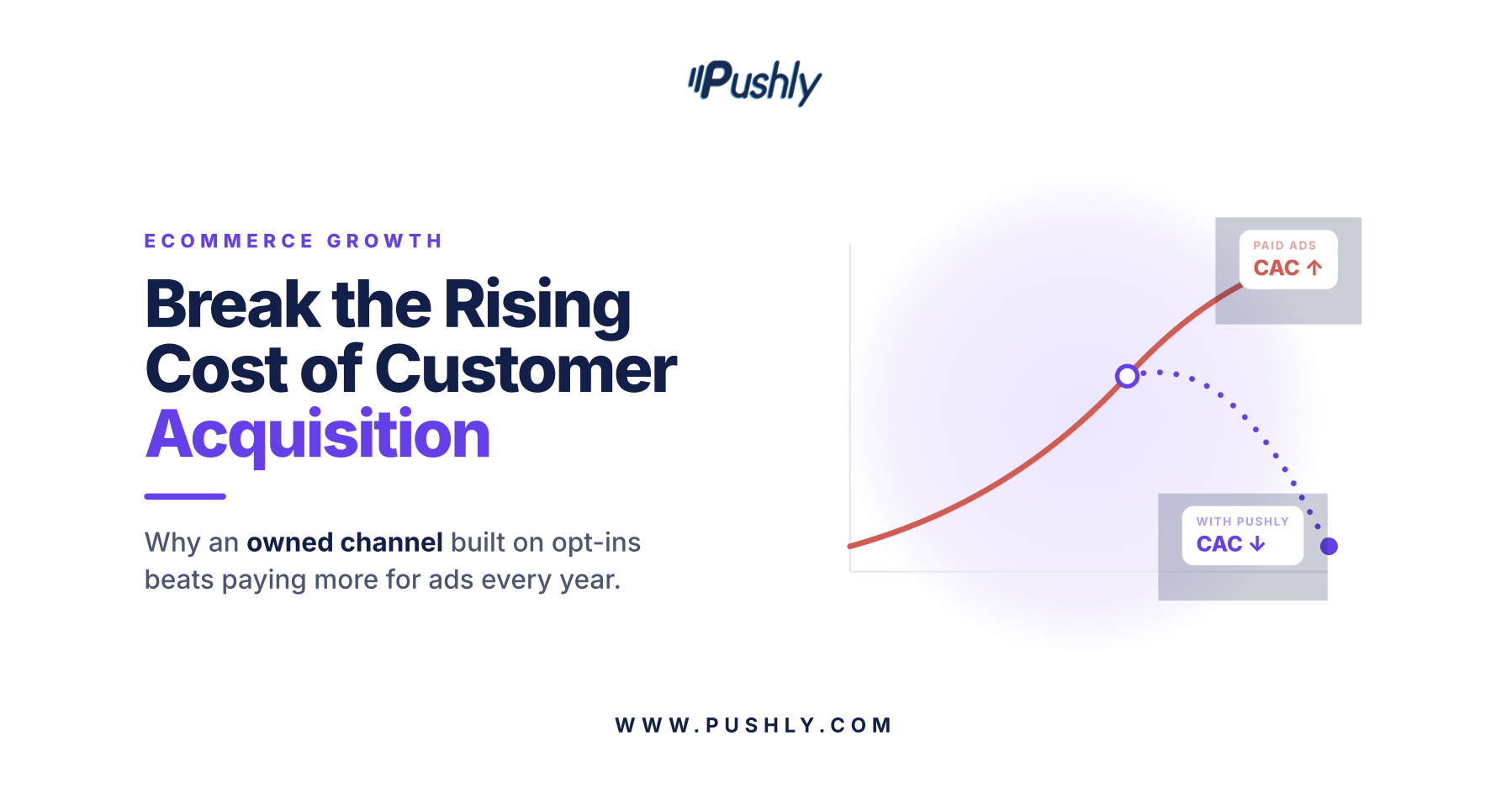
Customer acquisition keeps getting more expensive in 2026, and most ecommerce brands have accepted it as the cost of doing business. They raise their ad budgets, optimize their campaigns, and keep paying channels more every year.
But push notifications work differently. When a customer opts in, you gain a direct line to them that costs nothing to use and keep it for as long as the customer stays subscribed.
This article explains why customer acquisition costs keep rising, and why an owned channel built on opt-ins is the solution for ecommerce brands.
What is Customer Acquisition Cost?
Customer acquisition cost, or CAC, is the total amount you spend to win a single new customer. It covers everything that goes into turning a prospect into a buyer: ad spend, marketing salaries, software and tools, agency fees, and the creative work behind your campaigns.
To know whether that spend pays off, brands compare CAC against the total revenue a customer generates over their lifetime. The number matters because it sets the ceiling on how much you can spend to grow and still stay profitable. And when that cost rises, brands face a simple choice: spend more to keep acquiring at the same pace, or find a way to further engage the customers they already have.
Why is Customer Acquisition Cost Rising?
Customer acquisition cost keeps rising for several reasons:
Rising competition. More brands are selling online, and most of them acquire customers through the same handful of channels. When everyone bids for attention on Meta and Google, the price of that attention goes up.
Privacy changes. Changes around App Tracking Transparency and third-party cookies block the tracking that advertisers relied on. These shifts stripped away the data that made targeting precise. Without that precision in data, platforms struggle to show your ads to the people most likely to buy, and they struggle to prove which ads actually drove a sale.
Dependence on rented channels. The platforms set the prices, change the rules, and adjust their algorithms often, and many brands keep paying because they have no other way to reach the audience they’ve come to rely on.
Push Notifications That Re-Engage Shoppers
Rising customer acquisition costs hurt most when the customer buys once and never returns. The way to bring that cost down is to get more out of every customer you’ve already paid to acquire, and push gives you a direct, free line to do exactly that.
Each use case below reaches a customer you’ve already spent to win and moves them toward another purchase, without adding to your acquisition spend:
- Abandoned cart recovery. A shopper fills a cart and leaves without checking out. Push reaches them while the intent is still fresh and brings them back to the exact items they left behind.
- Browse abandonment. Someone views a product but never adds it to the cart. Push follows up and pulls them back to the page.
- Back-in-stock alerts. When a shopper wants something you are out of, push tells them the moment it returns, so you capture a sale that would otherwise go with an alternative.
- Price-drop alerts. Maybe a shopper eyed an item but did not buy it. When the price falls, push lets them know and closes the gap between interest and purchase.
- Replenishment reminders. Some shoppers buy things they will run through, like a refill or a consumable. Push reminds them to reorder right when they are due.
- Post-purchase cross-sells. Often, a shopper buys an item that pairs naturally with others. Push suggests the match soon after the order, drawing a second sale out of the first.
- Churn prevention. A customer’s visits and opens start to slow. Push reaches them while they are still engaged, with a reason to come back before they leave entirely.
- Win-back messages. When a customer has already gone quiet for a while, push reaches out with a reason to return and reactivates a buyer you would otherwise have to replace.
- Loyalty and rewards nudges. Other customers have points to spend or a reward about to expire. Push reminds them, giving them a reason to return and complete another purchase.
- Time-sensitive promotions. A sale or launch runs for a limited window. Push delivers the news instantly, while it still matters, instead of waiting for the customer to check back on their own.
Advantages of Push Notifications for Ecommerce Businesses
Push notifications help lower customer acquisition cost in a number of ways. Here is how they lower what an ecommerce brand spends to win and keep customers:
You reach customers directly, on a channel you own. Once a shopper opts in, you send messages straight to their device as often as you need. The biggest line item in acquisition is paying to reach people again and again. Push removes that line item for every customer who subscribes.
Recover the sales you already paid to win. Most shoppers who add to cart never check out, and every one of them arrived through traffic you paid for. Push lets you reach those shoppers automatically and bring them back with the exact products they left behind. You are not buying a new customer to replace the lost sale. You are closing a sale you have already spent to create, which lowers the real cost of every order.
Turn one purchase into many. A customer costs the same to acquire whether they buy once or ten times, so the more they return, the lower your effective acquisition cost spreads across each order. Push drives those repeat visits directly, with restock alerts, price drops, and timely reminders that pull customers back to buy again, none of which cost you anything to send.
Target instead of blasting, so your spend stays efficient. Push lets you reach shoppers based on what they browsed, what they bought, and how recently they visited. Relevant messages keep subscribers opted in and buying, while generic blasts drive them to unsubscribe. Retaining your subscriber base protects the channel you built, so you are not constantly spending to replace the audience you lost.
Follow the customer across web and mobile. Shoppers move between browser and app, and reaching them on both means you capture more sales from the same audience without paying a separate channel to do it. One opt-in works wherever the customer shops, stretching the value of every acquisition further.
Own Your Reach, Own Your Growth
Customer acquisition costs will keep rising. The channels are crowded, the targeting is weaker, and no amount of campaign tuning changes the fact that paid acquisition charges you every time you want to reach a customer. The good news is you can build something you own. Push notifications give you a direct line to a customer that costs nothing to use, and they keep working for as long as they stay subscribed.
Pushly gives you everything you need to do it. You reach customers across web and mobile, automate the journeys that recover carts and drive repeat purchases, target with precision, and reach your audience in less time. Want to explore how push notifications can help lower customer acquisition cost for your business? Book a demo with Pushly and start turning the customers you already pay to reach into revenue you own.
FAQs
Which push notification tools help ecommerce teams with customer re-engagement?
The strongest re-engagement tools automate outreach around customer behavior instead of relying on manual sends. Pushly’s automated journeys re-engage shoppers based on what they do, sending cart abandonment reminders, welcome messages, and follow-ups tied to the items a shopper viewed. You set the triggers once, and they run on their own, so your team brings customers back around the clock without sending each message by hand.
Which push notification platforms work best for ecommerce retailers?
The best fit is a platform that understands how people shop, not a generic messaging tool. Pushly tracks commerce events like product views, cart additions, and purchases, then uses that activity to trigger relevant messages and pull live product details into each notification. That makes it a natural fit for retailers who want their messaging tied directly to shopping behavior.
How do push notification platforms increase ecommerce revenue?
They recover sales you would lose and bring past buyers back to purchase again. Pushly reaches shoppers who abandon carts, alerts them when wanted items return or drop in price, and reminds them to reorder, all without paying to reach them again. Each recovered cart and repeat purchase adds revenue on top of the spend you already made, rather than requiring new acquisition dollars.
What push notification platforms support web and mobile ecommerce messaging?
Pushly supports both web push and native app push across iOS and Android, with SDKs for native, Flutter, and React Native apps. You build audiences, set up journeys, and send messages from one platform, whether the shopper is in a desktop browser or your mobile app, so your reach follows the customer instead of stopping at one device.
What are the top multichannel push notification platforms for retailers?
Look for a platform that unifies web and mobile reach and connects both to your shopping data. Pushly brings web and native app push together in one place, then layers on behavioral targeting, automated journeys, and commerce event tracking. Instead of managing separate tools for each channel, a retailer runs coordinated re-engagement across every device from a single platform.