Most marketing teams treat web push notifications as a “set it and forget it” channel. Send a message, hope for clicks, move on. The problem is that a handful of avoidable mistakes quietly erode subscriber trust, inflate opt-out rates, and leave revenue on the table. If your web push notifications are underperforming, the issue is rarely the channel itself.
Pushly helps publishers, ecommerce brands, and media teams identify exactly where their notification strategy breaks down. This article walks through the 8 most common web push mistakes that hurt re-engagement and revenue in 2026, then shows you how to correct each one.
Key Takeaways: Web Push Mistakes That Hurt Re-Engagement
- Sending the same notification to every subscriber destroys relevance and accelerates opt-outs across your audience
- Poorly timed permission prompts reduce opt-in rates before you ever get a chance to prove value
- Ignoring frequency controls leads to notification fatigue, which pushes even your most engaged subscribers toward unsubscribing
- Skipping behavior-based targeting means you miss the moments when subscribers are most likely to act
- Pushly gives publishers and ecommerce teams AI-driven segmentation that matches each notification to real user behavior
What are web push notifications?
Web push notifications are clickable messages that a website sends directly to a subscriber’s desktop or mobile browser, even when that person is not actively visiting the site. Visitors opt in with a single click through a browser permission prompt, and no email address, phone number, or app download is required. Once subscribed, they can receive alerts about breaking news, new articles, price drops, restocks, abandoned carts, and other timely updates.
Each notification typically includes:
- A short headline
- A brief message
- An icon or image
- A link that takes the subscriber back to a specific page
Because the messages appear on screen like native alerts, they capture attention quickly and give brands a direct line to their audience without relying on search rankings, social algorithms, or crowded inboxes.
For publishers, web push notifications drive return visits and build daily reading habits. For ecommerce brands, they recover lost sales and bring high-intent shoppers back to the storefront. When used strategically, web push becomes one of the most efficient channels for re-engaging an audience you have already earned, which is exactly why the mistakes in this article are so costly to ignore.
Common Web Push Notification Mistakes That Cost You Subscribers and Revenue
1. Asking for Permission Too Early
Firing a browser permission prompt for web push notifications the second someone lands on your site is the fastest way to get blocked. Visitors who haven’t yet seen your content have no reason to say yes. Once they decline, you cannot ask again on that browser.
Use a soft-ask approach instead. Let visitors engage with your content first, then display a contextual prompt that explains what they will receive and how often. Pushly’s opt-in tools let you customize permission prompts with clear value statements, so subscribers know exactly what they are signing up for.
2. Treating Every Subscriber the Same
Sending one notification to your entire list ignores the fact that a sports reader and a finance reader respond to completely different content. This approach produces low click-through rates and high unsubscribe rates because the message is irrelevant for most recipients.
Segment your audience by behavior, interest, and engagement history. Pushly’s audience segmentation uses first-party data to create targeted groups so each notification reaches the subscribers most likely to engage with it. The result is higher relevance per message and fewer opt-outs across your list.
3. Ignoring Send Timing and Frequency
Flooding subscribers with web push notifications during off-hours or sending five alerts in a single morning creates fatigue. According to a 2025 Batch push notification benchmark study, contextual notifications triggered by real user behavior outperform manually scheduled campaigns in both click-through rate and retention.
Cap your send frequency and match delivery to the times your audience is most active. Pushly’s campaign orchestration tools include throttling controls, frequency caps, and AI-optimized send times that protect subscriber retention while maximizing engagement across your web and mobile channels.
4. Writing Vague, Clickbait-Style Copy
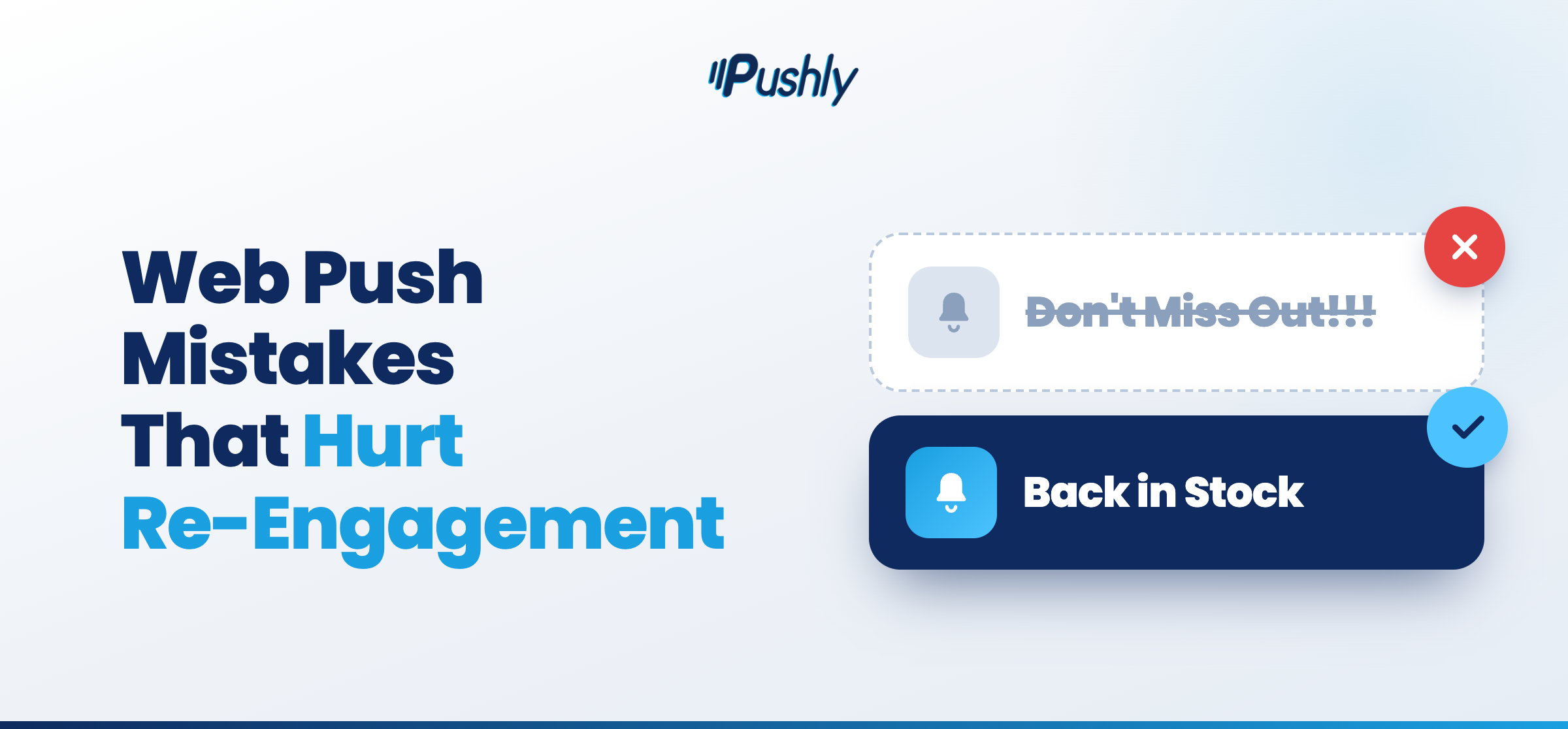
Headlines like “You Won’t Believe This!” or “Don’t Miss Out!” erode trust quickly. Subscribers learn to ignore notifications that promise everything and deliver nothing specific. Over time, that learned behavior turns into a permanent opt-out.
Write copy that states the value upfront. Tell the subscriber exactly what they will find when they click. For ecommerce teams, that means a specific product name, price-drop alert, or restock update. For publishers, it means the story topic and why it matters right now. Specificity drives clicks.
5. Skipping Behavior-Based Triggers
Manual, one-time campaign sends miss the moments when subscribers are most likely to act. A shopper who just abandoned a cart or a reader who regularly visits your health section at lunchtime represents a real-time opportunity that you should act on immediately. A scheduled, calendar-based send cannot capture that level of intent.
Automate web push notifications based on real user actions instead. Pushly’s cart recovery sequences and content-driven Journeys trigger messages at the exact moment a subscriber’s behavior signals purchase or engagement intent, turning missed moments into measurable revenue.
6. Not Measuring What Matters
Tracking impressions or total sends without connecting them to downstream actions gives you a distorted picture of performance. You end up optimizing for volume instead of outcomes like repeat visits, subscriptions, or purchases. That disconnect compounds over time.
Focus on metrics that map to your business goals. Click-through rate, subscriber retention rate, repeat session rate, and revenue attribution per notification tell you whether each message drove a meaningful result. Pushly’s Analytics and Insights dashboard surfaces these performance signals in real time so you can adjust strategy quickly.
7. Neglecting Personalization Beyond a First Name
Inserting a subscriber’s name into a notification is a start, but genuine personalization goes further. It means matching content to what each individual subscriber has browsed, clicked, or purchased over time. Without that depth, web push notifications still feel impersonal to the reader and click-through rates plateau.
Use behavioral data to personalize the content itself. Pushly’s reader behavior-based segmentation and AI-driven content recirculation deliver the right article or product to each subscriber based on their individual engagement history, so every notification feels relevant.
8. Failing to Build an Onboarding Sequence
Many teams collect the opt-in and then immediately start sending promotional content. New subscribers who have not yet built a relationship with your brand are the most likely to unsubscribe when the first irrelevant push arrives. That early churn wastes the opt-in you worked to earn.
Create a welcome journey that introduces your brand and sets expectations. Pushly’s onboarding automation lets you sequence welcome messages, highlight your content or product catalog, and ease new subscribers into your regular notification cadence over the first several days.
Why Avoiding These Mistakes Protects Your Subscriber Base and Revenue
Every mistake on this list compounds over time:
- Poor opt-in prompts reduce your reachable audience
- Irrelevant content accelerates churn
- Missing triggers leave revenue uncaptured
Fixing even two or three of these issues can produce a noticeable improvement in repeat visits, subscriber retention, and conversion rates.
For publishers, that means more return readers, higher page views per session, and stronger ad revenue. For ecommerce teams, it means recovered carts, repeat purchases, and a growing base of loyal subscribers you can reach directly without paying for re-acquisition.
Pushly gives you the targeting, automation, and measurement tools to correct these mistakes from day one. If you are ready to turn your web push channel into a genuine revenue engine, book a demo today and get started with Pushly.
FAQs About Web Push Notification Mistakes
How do marketing teams use push notification platforms to re-engage website visitors?
Marketing teams use push to follow up with visitors who left without sharing an email address or creating an account. The visitor opts in with one click, the platform records what they viewed, and a later notification brings them back for something tied to that visit, such as a new story in a section they read or a product they looked at.
How do digital publishers use push notifications to grow subscriber engagement?
Publishers grow engagement by letting readers follow the sections they care about, then delivering new stories from those sections as they publish while reserving breaking alerts for news that justifies an interruption. Editors decide what goes out and the audience team tunes frequency, so the channel stays useful instead of becoming noise.
How do ecommerce teams improve revenue impact from web push notifications?
Revenue from web push comes from sends triggered by shopper intent rather than broadcasts to the whole list. Abandoned cart reminders, price-drop alerts, back-in-stock notices, and browse-abandonment follow-ups fire from storefront events, and the platform attributes the resulting orders to each notification.
How do web push notifications help publishers reduce audience churn?
Most readers visit once and never return because nothing reminds them to. A push subscriber receives that reminder, and the habit of tapping through turns a one-time visitor into a regular. You can reduce churn by avoiding mass sends. That means sending by section, respecting quiet hours, and holding frequency below the point where readers switch notifications off. Web push platforms with segmentation and frequency caps can support that.
Which push notification platforms support AI-driven targeting for web and mobile?
Nearly every engagement platform advertises AI- driven targeting. Airship and Braze use predictive models to pick send times and audiences across app and web, while MoEngage applies behavioral prediction built for mobile apps. Pushly uses AI-powered personalization to optimize push notification send times, content selection, and audience segmentation based on first-party behavioral signals across web push, mobile push, and in-app.
How do ecommerce brands improve audience segmentation for onsite notifications?
Onsite notifications perform best when they respond to the visitor’s current session rather than their purchase history. Ecommerce brands improve segmentation by building a first-party shopper profile from every browse and purchase. This syncs to their CDP, so onsite and push targeting draw on the same data.
It takes into account things like pages viewed right now, the contents of the cart, whether the visitor is new or returning, and where they came from, and the message reads as helpful instead of intrusive.
How do web push notifications impact ecommerce site conversion rates?
Web push notifications lift conversion by creating return sessions that would not have happened otherwise, and those sessions convert better than cold traffic because the shopper comes back with intent. The effect shows up in attributed revenue and return-visit frequency rather than in a blended site-wide conversion rate, so measure it per notification.