Push notifications are one of the highest-return channels in ecommerce. They recover carts, flag back-in-stock and price drops, and win shoppers back without paying to reacquire them, all through messages that reach a subscriber’s screen the moment they matter.
But most platforms sold for the job aren’t push platforms. They’re email suites, CDPs, or all-in-one clouds where push is one channel among many. That matters: when push is one of the eight things a vendor sells, it gets a fraction of the investment. When push is the product, it gets built to actually drive performance: subscriber opt-in, deliverability, and revenue.
We evaluated dozens of push notification platforms to identify the top providers for ecommerce in 2026, so you can make an informed decision.
Our Selection Process
We evaluated every platform on the same criteria, weighted for what actually determines push performance in ecommerce. Each platform was assessed on:
- Web push depth across all major browsers, on desktop and mobile web
- Mobile push on iOS and Android
- Opt-in and subscriber growth tools, including A/B-tested prompts
- Deliverability and render rates
- Behavioral segmentation using first-party data
- Commerce triggers for cart, browse, back-in-stock, price drop, and post-purchase
- Personalization with dynamic product content
- Automation and journeys
- Analytics tied to conversions and revenue
- Stack fit, or how well push integrates with your existing tools
- Ease of use and speed to launch
- Pricing and value
What Are Ecommerce Push Notification Platforms?
An ecommerce push notification platform is software that sends clickable messages to shoppers’ browsers and mobile devices to drive them back to your store. Unlike email or SMS, push reaches subscribers instantly on their lock screen or desktop, with no address or phone number required.
For ecommerce, these platforms connect to shopper behavior. They track product views, cart activity, and purchases, then trigger timely messages: an abandoned-cart nudge, a back-in-stock alert, a price-drop notice. The best ones handle both web push, sent through the browser, and mobile app push, sent to iOS and Android, from one place.
Web Push vs. Mobile Push vs. In-App Messaging
Push notifications come in a few forms:
Web push is sent through the browser to desktop and mobile web visitors. Shoppers opt in with one click, which makes it the fastest way to build a reachable audience from your existing site traffic. It reaches subscribers even when they’re not on your site.
Mobile push is sent to a shopper’s phone through your native iOS or Android app. It’s powerful for brands with an app and an engaged base, reaching people who have downloaded and allowed notifications.
In-app messages appear while a shopper is actively using your app. They’re useful for onboarding, promotions, and guiding behavior in the moment.
Why Push Notifications Matter for Ecommerce Retention
Acquiring a new customer costs far more than keeping one, so the brands that win on margin are the ones that bring existing shoppers back. Pushly is built for exactly that. It reaches subscribers instantly, costs nothing per send, and doesn’t depend on an inbox or algorithm.
Push closes the gaps that other channels leave. Roughly seven in ten carts get abandoned, and email recovers only the shoppers who gave you an address and actually open it. Push reaches the rest, the moment they leave, with the product still in mind. The same speed drives back-in-stock and price-drop alerts, where minutes decide whether the sale is yours or a competitor’s.
It also compounds. Every opted-in visitor becomes a subscriber you can reach for free, again and again, without paying to retarget them. Over time, that owned audience becomes one of the cheapest retention channels a store has.
Key Features to Look for in an Ecommerce Push Notification Platform
Evaluate these capabilities when deciding on a push notification platform:
- Web push across every browser. Look for one-click opt-in and reliable delivery across Chrome, Safari, Firefox, and Edge, on both desktop and mobile web. This is the fastest way to build a reachable audience, and it’s where platforms vary most.
- Behavioral segmentation on first-party data. The ecommerce push notification platform should be able to segment shoppers by real behavior, product views, cart activity, and past purchases.
- Commerce triggers. Pre-built automations for abandoned cart, browse abandonment, back-in-stock, price drop, and post-purchase.
- Revenue analytics. Reporting that ties notifications to conversions and revenue, not just opens and clicks, so you can prove and improve ROI.
- Stack fit. Clean integration with your ecommerce platform and existing email or SMS tools, so push coordinates with the rest of your marketing.
Push Notification Use Cases for Ecommerce
Push works across the full shopper lifecycle. Here are some of the use cases for ecommerce push notifications:
Cart abandonment triggers a reminder minutes after a shopper leaves items behind.
Browse abandonment follows up when someone views a product or category but doesn’t add to cart.
Back-in-stock alerts let shoppers subscribe to sold-out items and notify them the moment stock returns.
Price-drop notifications message shoppers when a product they viewed or wanted goes on sale, turning passive interest into a purchase.
Post-purchase and order updates send shipping and delivery notifications that keep customers informed and coming back, then follow with replenishment or cross-sell prompts timed to the product.
Win-back and re-engagement reach lapsed subscribers with new arrivals, offers, or reminders to reactivate customers who have gone quiet.
Flash sales and launches announce limited-time drops and sales instantly to your whole subscriber base.
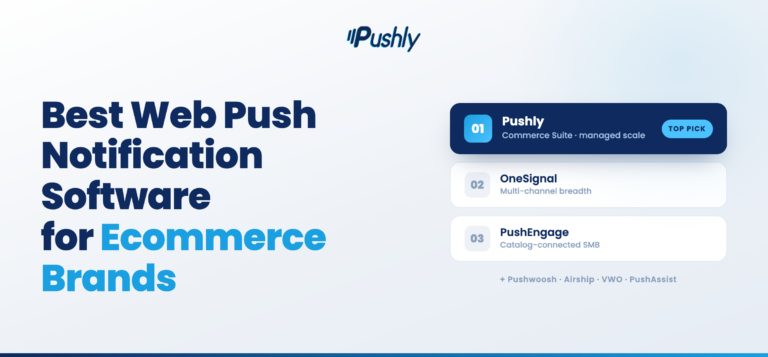
What are the Best Ecommerce Push Notification Platforms in 2026?
- Pushly
- Braze
- Iterable
- Klaviyo
- MoEngage
- CleverTap
- Airship
- OneSignal
- PushEngage
1. Pushly
Pushly is a top push notification platform built around push as its core product. It has focused on web push, mobile push, and app messaging since 2017, and its commerce-focused offering, Pushly for Commerce, is purpose-built for online retailers. Pushly is best for ecommerce teams that want push done at specialist depth.
Key Features
- Runs web push across all major browsers, native iOS and Android app push, and in-app messaging from a single campaign builder, with shared audiences and analytics across channels
- Connects to your product catalog and feed, pulling live product data (name, price, image, availability) into notifications for product-level personalization at scale
- Tracks the full range of commerce events, view item, save or wishlist, add to cart, cart updates, purchase, and ratings, that power abandoned-cart, browse-abandonment, back-in-stock, saved-item, and post-purchase flows
- AI-powered segmentation on first-party and zero-party data, so you target by behavior, events, and purchase history without relying on third-party cookies
- AI-driven automation that builds personalized journeys and adapts them in real time to optimize content, timing, and conversion
- Built-in revenue attribution ties every send to purchase value and order ID, so you can report revenue per push, recovered cart revenue, AOV, and subscriber LTV
- A/B testing, geotargeting, scheduling, and rich, interactive media built in
- Integrates with Shopify, major customer data platforms like BlueConic and Lytics, and the email or ESP tools already in your stack
Pros
- Push is the product, not a side feature, so Pushly invests in what actually drive results
- Recovers anonymous and guest revenue that other channels miss: shoppers can opt in to web push the first time they land, before creating an account or handing over an email, turning one-time guests into a reachable, repeat audience
- Intelligent frequency and audience-health controls fire triggers only when purchase intent is genuinely meaningful, protecting high-value customers from over-messaging and keeping opt-out rates low
- Covers the entire lifecycle in one place: welcome series, browse abandonment, cart recovery, back-in-stock and price-drop alerts, upsell and cross-sell, order updates, and win-back
- Complements the stack you already run, ingesting data from your ecommerce platform and CDP, so push coordinates with email and SMS instead of replacing them
- Recognized on G2 as a High Performer, Best Estimated ROI, and Easiest to Do Business With, reflecting fast setup and quick time to value
Cons
Pushly doesn’t sell email or SMS as native channels; it is a push specialist. It fits alongside email and SMS in your stack, so clients can easily pair Pushly with current tools rather than replace them.
Pricing
Custom, quote-based, aligned to your subscriber base and use case. Offers a 90-day pilot, and reviewers consistently rate Pushly high on ease of setup and speed to ROI.
2. Braze
Braze is an enterprise customer engagement platform that coordinates messaging across many channels.
Key features: Mobile and web push, email, SMS, in-app, content cards, and WhatsApp, orchestrated through Canvas, its visual journey builder, with AI-powered decisioning and real-time triggering.
Pros: Strong at complex, multi-step journeys, personalized product recommendations, and abandoned-cart sequences.
Cons: Expensive and complex, with real engineering and management overhead, which makes it overkill for lean or mid-sized teams. Push is also one of many channels rather than the main focus.
Pricing: Quote-based, priced on monthly active users, message volume, and tier.
3. Iterable
Iterable is an AI-powered cross-channel marketing platform that unifies email, SMS, push, in-app, and web push in one workflow. Like Braze, it’s a broad suite where push is one channel among several.
Key features: Workflow Studio builds multi-step journeys with branching logic, A/B testing, and cross-channel coordination, so a push can fire as a follow-up when an email goes unopened.
Pros: Strong multichannel breadth and API flexibility, well-suited to coordinated sequences across email, push, and in-app. It serves ecommerce alongside other industries: media, healthcare, SaaS, etc.
Cons: Enterprise pricing with reported cost uncertainty. Complex for small teams.
Pricing: Quote-based.
4. Klaviyo
Klaviyo is an ecommerce-native marketing platform, dominant on Shopify, led by email and SMS with mobile push as an add-on.
Key features: Email, SMS, WhatsApp, and mobile app push, built on a deep Shopify data model. No-code back-in-stock forms, coupons that stack at checkout, a Customer Hub with an AI chatbot and self-service order tracking, plus automatic send-time and UTM handling.
Pros: Best-in-class ecommerce integrations and shopper data, with strong flows for carts, back-in-stock, and post-purchase. If email is your primary channel, few tools match its ecommerce tuning.
Cons: Push is mobile-app-focused and secondary to email and SMS, and there’s no real web push, so it can’t turn anonymous site traffic into a push subscriber list the way a specialist does. Costs also climb steadily as your profile count grows.
Pricing: Transparent and usage-based.
5. MoEngage
MoEngage is an AI-driven omnichannel engagement platform. Push is well-developed, but it sits inside a broad channel suite.
Key features: Mobile and web push, email, SMS, in-app, on-site messaging, and WhatsApp, with Merlin AI for best-time-to-send and next-best-action. Push Amplification+ is a notable differentiator, lifting Android delivery rates, alongside frequency capping and journey analytics.
Pros: Solid cart-recovery and lifecycle tooling, unlimited push and web push on its entry plan, and WhatsApp bundled into base pricing without per-message fees beyond MAUs. Strong segmentation for scaling brands.
Cons: Enterprise-oriented, with heavier setup, and some capabilities like journey analytics and AI offer decisioning come as paid add-ons. Push is one channel across a large platform rather than the core focus.
Pricing: Plans and tiers are quote-based.
6. CleverTap
CleverTap is a mobile-first customer engagement and retention platform known for deep analytics. Push is a core channel, but the platform is built around the app experience.
Key features: Push, email, WhatsApp, in-app, web, RCS, and SMS, with a visual journey builder and automated segmentation that sorts users from champions to at-risk and hibernating.
Pros: Strong retention and lifecycle tooling, with coordinated programs, onboarding, churn prevention, and promotions, running together, backed by detailed behavioral analytics.
Cons: Mobile-first orientation means web push and browser-based subscriber growth get less emphasis, and the platform carries a learning curve.
Pricing: A 14-day free trial covers apps up to 100k monthly active users; Growth, Advanced, and Enterprise plans are quote-based.
7. Airship
Airship is an enterprise mobile app experience platform and an original push vendor, primarily for native apps.
Key features: App and web push, in-app, SMS, and email, plus a no-code Experience Editor for building app and web experiences without developers. Segmentation, journey mapping, A/B testing, message attribution, and full API access round it out.
Pros: Strong mobile-app personalization, testing, and analytics for brands whose customers live in the app.
Cons: App-centric, so it fits less naturally for brands led by web storefronts.
Pricing: Quote-based and negotiated per contract, with no published rates.
8.OneSignal
OneSignal is a push, email, and SMS platform.
Key features: Push across iOS, Android, and web, plus in-app, email, and SMS, with segmentation, journeys, real-time analytics, and rich media notifications. Broad device and platform support and quick setup.
Pros: Fast to deploy for both web and mobile push, and it scales to high subscriber counts, which suits teams that want push volume without a big contract.
Cons: Ecommerce features are general-purpose rather than retail-specialized, with no pre-built commerce triggers like cart recovery out of the box. As subscriber counts grow, its usage-based pricing starts to behave more like infrastructure billing, and journeys and segments are limited on the free tier.
Pricing: Transparent and usage-based.
9. PushEngage
PushEngage is a web-push specialist that is affordable and focused, with cart recovery as its signature use case.
Key features: Web push and PWA push, with some mobile push, and ecommerce automations, dynamic product tags, price-drop, and back-in-stock triggers, plus a WhatsApp click-to-chat widget. Integrates with WooCommerce and Shopify.
Pros: Purpose-built cart-abandonment and re-engagement workflows that ship ready to use. Genuinely strong value for small stores.
Cons: Narrow by design, it centers on web push, with fewer enterprise-grade features. Mobile app push is limited compared with dedicated mobile platforms.
Pricing: Very affordable.
Best Ecommerce Push Notification Platforms
Here’s a quick look at our picks for the best ecommerce push notification platforms:
Platform | Best for | Type | Commerce triggers |
Pushly | Ecommerce push, done deeply | Push specialist (web, mobile, in-app messaging) | Yes (cart, browse, back-in-stock, wishlist) |
Braze | Enterprise omnichannel orchestration | Full suite | Via Canvas journeys |
Iterable | Enterprise omnichannel orchestration | Full suite | Configurable |
Klaviyo | Shopify brands adding push to email/SMS | Ecommerce suite (email-led) | Strong |
MoEngage | Omnichannel personalization at scale | Full suite | Yes |
CleverTap | Mobile-first retention and analytics | Mobile engagement suite | Yes |
Airship | Enterprise mobile app messaging | Mobile-first suite | Configurable |
OneSignal | Web and mobile push | Push-first (now multichannel) | Limited |
PushEngage | Web push | Web push specialist | Strong (pre-built) |
Why Pushly is the Best Ecommerce Push Notification Platform
Choosing Pushly means choosing a partner that lives and breathes one channel. While the suites divide their roadmap across email, SMS, and everything else, Pushly’s entire team, product, infrastructure, and support model exist to make push perform for your store.
That shows up in how fast brands get live, how quickly they see returns, and in the recognition Pushly has earned for ROI and ease of doing business. For an ecommerce team, that means less time wrestling software and more revenue from a channel the Pushly team is genuinely obsessed with getting right.
Choosing the Right Push Platform for Your Ecommerce Store
The best platform depends on what you’re actually solving for. If you want one vendor for every channel and have the budget and team to run it, an enterprise suite like Braze, Iterable, or MoEngage delivers broad orchestration. For brands with email as a primary channel who are on Shopify, Klaviyo keeps push close to your ecommerce data.
If push is a channel you want to take seriously, not just switch on, Pushly is the platform on this list built for it. Web and mobile push from one place, first-party behavioral targeting, and commerce triggers like cart recovery and back-in-stock, all engineered as the core product rather than an add-on. Pushly for Commerce brings that focus to online retailers specifically, and it complements the email and SMS tools you already run instead of replacing them.
If you want push to be a real revenue channel for your store, book a demo with Pushly today.
FAQs
Which push notification tools help ecommerce teams with customer re-engagement?
Push platforms drive re-engagement by triggering messages off shopper behavior: abandoned-cart reminders, browse-abandonment follow-ups, back-in-stock and price-drop alerts, and win-back campaigns for lapsed customers. Pushly, PushEngage, MoEngage, and CleverTap all offer behavior-triggered re-engagement, with Pushly focused specifically on push depth and first-party behavioral targeting. It’s a far cheaper way to recover revenue than paying to reacquire the same shoppers.
What are the top multichannel push notification platforms for retailers?
A multichannel push platform reaches shoppers across every push surface, web push in the browser, native app push on iOS and Android, and in-app messaging, from one campaign builder with shared audiences and analytics. Pushly is the top multichannel push notification platform, unifying all three push channels with product-level personalization and revenue attribution built for retail.
Which push notification platforms work best for ecommerce retailers?
The best fit depends on your priority. Pushly is the strongest choice for retailers who want push done at specialist depth, Klaviyo suits Shopify brands led by email, and Braze, Iterable, and Airship serve enterprise and mobile-first needs. For push performance specifically, a specialist beats a suite where push is one feature of many.
What is the best push notification platform for omnichannel ecommerce marketing?
For omnichannel marketing from a single vendor, MoEngage and Iterable are the top options, coordinating push, email, SMS, in-app, and WhatsApp in one platform. If your goal is the strongest push channel within an omnichannel stack, a specialist like Pushly plugs into your existing tools and outperforms the push module built into a suite.
What push notification platforms support web and mobile ecommerce messaging?
Platforms that handle both browser-based web push and native iOS and Android app push include Pushly, OneSignal, MoEngage, and Braze. Pushly and OneSignal treat web push as a first-class channel, which matters because web push turns anonymous site traffic into a subscriber list. Some tools, like Klaviyo, focus on mobile app push and offer little or no web push.
Which push notification software is best for mid-sized ecommerce brands?
Mid-sized brands usually need strong results without enterprise pricing or complexity. Pushly fits this well, offering specialist push depth that complements an existing email or SMS tool. Enterprise suites like Braze and Iterable tend to be heavier and pricier than mid-sized teams require.