Retail media is now a standard part of the media plan in 2026. After search and social, it has become the third wave of digital advertising, built not on borrowed audiences but on the retailer’s own shoppers. Brands buy sponsored placements on retailer websites, using them to target ads across the web or on screens inside stores. All of these placements work the same way: they reach a shopper who is already shopping.
Push notifications are different. They reach a shopper directly, wherever they are, which is why more retailers are starting to treat push as part of their retail media network rather than just a tool for sending order updates and alerts.
This article covers what a retail media network is, where ecommerce push notifications fit inside one, and what a push placement looks like as a line item on a media plan.
What is a retail media network?
Retail media networks are the advertising business that retailers build on top of their own audiences. The retailer sells access to its shoppers across its site, app, physical stores, and beyond, and targets those placements with the first-party data it collects every time a customer browses, subscribes, or buys.
Because the ad and the sale happen inside the same ecosystem, the retailer can connect the two and report which impressions produced which sales. That closed loop is the defining feature of the category, and sets retail media apart from most other advertising.
The idea is not new. Brands have paid retailers for prominent placement in stores for decades, back when that meant physical shelf space and printed promotions. What changed is that the whole thing moved online. For a lot of brands, this is not new spending; it is money that used to go toward in-store promotion now going toward retailer audiences instead.
A few forces turned retail media into a more established channel. Privacy changes made third-party tracking unreliable, which turned retailers’ first-party purchase data into some of the most valuable targeting material in advertising. Advertising also earns higher margins, so any retailer with enough shoppers has a reason to build one.
Today, retailers of nearly every size and category operate a media network. Some popular ones include:
- Amazon Retail Ad Service
- Walmart Connect
- Target Roundel
- Kroger Precision Marketing
- Instacart Ads
What are the benefits of retail media networks?
There are four main benefits of retail media networks:
Better targeting. A retailer’s transaction history shows who buys in a category, who used to buy and stopped, and who just switched to a competitor. No modeled or inferred audience matches that precision, and some of those audiences, like a competitor’s customer base, a brand could never reach on its own.
Reach people while they shop. Retail media reaches people while they shop, inside the search results, the category page, and the cart, landing right in that high-intent moment when the shopper is deciding what to buy.
Brands can see what actually sold. Because the retailer records both the ad impression and the sale, brands can judge campaigns on the revenue they actually produced rather than on proxies like clicks or estimated views.
It keeps working as tracking disappears. Shoppers give retailers their data directly, by making accounts, joining loyalty programs, and making purchases, so the model never depended on third-party cookies and keeps working as cross-site tracking disappears.
The types of retail media inventory
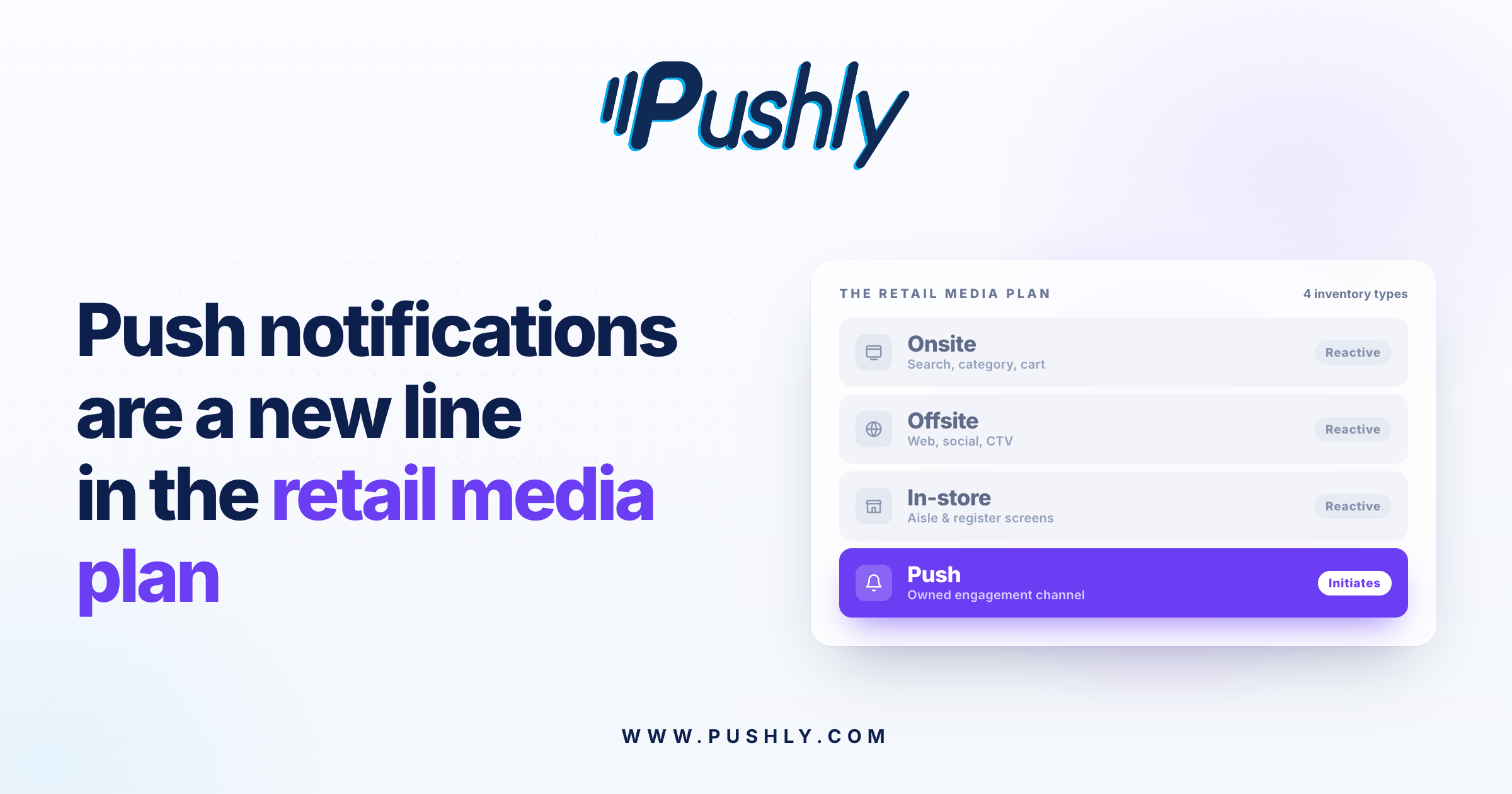
Retail media inventory comes in three established types, with a fourth now taking shape.
Onsite inventory sits on the retailer’s own website and app. A brand buys sponsored placements inside search results and on category pages, banner/ display ads on the home page and product pages, and featured spots along the way to checkout. This is where retail media started, and it is still where most of the spend is concentrated.
Offsite inventory is the retailer using its data to place ads elsewhere. The retailer takes what it knows about its shoppers, say, everyone who recently bought coffee, or everyone loyal to a competing brand, and targets ads to those exact people on other websites, in social feeds, and on streaming TV. Another publisher displays the ad, but the retailer’s data decides who sees it, and the retailer records the transaction.
In-store inventory advertises inside the physical store. Digital screens at the entrance, in the aisle, and at the register carry brand ads while the shopper is in the store, often standing right next to the product.
These first three types work the same way: they are reactive. Each waits for the shopper to act first, to run a search, load a page, watch a program, or walk into a store. There is a fourth type of retail media inventory now emerging:
Owned engagement channels. Channels like push notifications reach people directly, giving retailers leverage to initiate contact instead of waiting to react to the shopper’s behavior. Retailers built these channels to do their own marketing, and now some are starting to sell space inside them to brands.
Where do push notifications fit in retail media networks?
Retail media historically positioned a brand inside a moment the shopper started. Ecommerce push notifications work the other way around. This is the only channel in the retail media stack that the retailer owns end-to-end, using its data to decide who receives the message, what it says, when it arrives, and where the tap takes them. The shopper on the other end is not an anonymous visitor, but a shopper the retailer can match to an account and a full purchase history before the message goes out.
This changes the economics of the whole plan. Onsite, offsite, and in-store placements monetize attention. Push creates the attention. The retailer sends the message, the shopper taps, and a shopping session begins that no search, page view, or store visit produced.
Push notifications vs push as retail media
Most people know push notifications as a message a brand sends to its own opted-in subscribers: an order update, a flash sale alert, etc. The brand owns its audience and sends on its own behalf.
Push as retail media flips that. A brand pays to reach a retailer’s shoppers, targeted with the retailer’s purchase data, with the tap landing on the brand’s product page inside the retailer’s store. The message still arrives the same way, on the phone, from the retailer. What is new is that a brand paid for it, chose who it reached, and sent them straight to its own product on the retailer’s shelf. None of this replaces a brand’s own push program. It reaches a different, larger audience.
The benefits of adding push to a retail media plan
Plenty of brands already send push notifications and have access to their own first-party data. So it is worth exploring why a brand would pay a retailer to send push on its behalf:
- The retailer reaches people the brand cannot. A brand’s own push list is limited to people who opted in directly on its site. Retailers have far larger lists, which include people who buy in a category but have never engaged with a specific brand, and people currently buying a competitor’s product.
- Access to far more targeting data. A brand knows what people bought from them. A retailer knows what people bought across every brand in any category, letting the retailer build audiences that a brand cannot build for itself.
- Increased purchase activity. When a brand sends a push notification, it still has to get the shopper to go buy the product somewhere. For most packaged goods, that somewhere is the retailer. Retail media push lands on the product page in the store where the shopper already checks out, so the path from message to purchase is a single step.
Push notification ad formats in retail media
These placements take four forms:
A dedicated send gives the whole notification to one brand. The retailer sends it, but the product, the message, and the destination link all belong to the sponsor, and no other advertiser is on the screen. The retailer builds the audience from its records: lapsed buyers in the brand’s category, buyers of a complementary product, members of a loyalty tier, or shoppers in a specific city for a launch.
A sponsored slot puts a brand inside a notification the retailer was already going to send. Retailers push their own deal roundups, sales & promotions, and alerts, and a brand pays for a featured position within one. The retailer keeps its own voice and framing; the brand buys a place within it.
A sponsored triggered placement runs continuously instead of on a schedule. Retailers automate ecommerce push notifications to fire on shopper behavior: a browsed item drops in price, a watched product comes back in stock, a cart sits unfinished. When more than one product qualifies for the alert, sponsorship decides which one the shopper sees.
A bundled program sells push as one piece of a bigger package. Retailers assemble omnichannel programs around seasonal events and product launches, with placements across onsite, offsite, and in-store inventory, and push takes the role no other component can play: bringing shoppers in once the event is live.
How push strengthens the rest of the retail media stack
A push placement keeps paying off after the tap, with more traffic, sharper data, and proof that the ads worked.
Take onsite ads, the sponsored products, and banners on the retailer’s own site. Those ads only earn money when someone is on the site looking at them. Push sends people directly to the site, so every push sent increases traffic and ad views, which in turn leads to more sales.
For offsite ads, the retailer uses its data to target ads on other websites. Every push subscription, tap, and purchase tells the retailer more about each shopper, so its targeting gets more precise. And because a subscription is a direct line to the shopper, that data keeps working even as cookie tracking goes away.
Take in-store ads, the screens in the aisles. A screen has no way of knowing who walked past it, so the retailer could never prove those ads led to sales. Push fixes that attribution gap. The retailer sends a shopper a message before the trip, and when the shopper’s loyalty account shows up at the register, it can connect the message to the purchase. Now it can show the ads work.
Then the loop closes. Every purchase these visits produce tells the retailer more about its shoppers, which makes the next push send sharper. And a brand that buys push and onsite ads together gets both at once: its onsite ads are seen by the shoppers its own push brought in.
Give push notifications their own line on the media plan
Retail media has long earned its place in the ecommerce industry. Now, in 2026, push ushers in a new frontier. It lets the retailer pick a shopper from its purchase records, sends a message featuring a brand’s product, and opens a shopping trip that was not going to happen. That matters more every year as search traffic declines, and the need for more direct lines to shoppers increases.
If you’ve been thinking about retail media networks and want to add a channel that brings shoppers in rather than waits for them, book a demo with Pushly, and we will show you what push can do for your network.
FAQs
What are the top multichannel push notification platforms for retailers?
The top multichannel platforms let a retailer send web push, app push, in-app messages, email, and SMS from one system, using a single profile for each shopper across every channel. Pushly, Braze, and Airship are strong push platforms. Pushly stands out, with strong ecommerce capabilities: it connects directly to a retailer’s product catalog and purchase data, sends across web and app from one profile, and ties every send to the sale that followed. For a retailer that wants push to work as both a marketing channel and retail media inventory, Pushly is the platform to start with.
Why do ecommerce sites struggle with push notification engagement?
Most push notification engagement problems trace to one cause: the push program runs disconnected from the site’s commerce data, so messages are generic. Engagement recovers when the program is built on store data: messages tied to what someone actually browsed and bought, sent to the right segment, linking straight to the relevant product. This is exactly what Pushly is built to do, which is why retailers on Pushly see engagement that generic messaging tools cannot match.
What causes cart abandonment campaigns with push notifications to underperform?
Cart abandonment campaigns often underperform due to timing and data. The message fires too early and interrupts someone still deciding, or too late, after the moment has passed. Every one of these traces back to a push tool that is not fully wired into the store’s cart and purchase data. Pushly connects to that data directly, so abandonment campaigns fire at the right moment, name the exact products left behind, stop sending once the purchase is made, and link straight back to the waiting cart.
Which push notification platforms work best for ecommerce retailers?
The platforms that work best for ecommerce retailers are the ones built around the product catalog and the transaction. An ecommerce-ready platform pulls in product and purchase data automatically, runs triggered campaigns for abandoned carts, price drops, and restocks without custom engineering. Braze and Airship can do much of this at the enterprise level, and Klaviyo is strong, but mostly limited to retailers who lead with email. For a platform focused specifically on push and built around commerce data end to end, Pushly is the best fit for ecommerce retailers, because every one of those capabilities is core to the product rather than an add-on.
How do push notification platforms increase ecommerce revenue?
Push notification platforms increase revenue in two ways. As a marketing channel, push recovers abandoned carts, tells shoppers when a product they wanted drops in price or comes back in stock, and brings back customers who have lapsed, all without paying for media. As retail media inventory, push notifications become a channel the retailer sells: brands pay to place their products in the retailer’s push notifications, which turns push from a cost into a source of ad revenue. Pushly is built to do both, which is why it increases ecommerce revenue on two fronts at once: driving sales through the retailer’s own marketing and opening new advertising business revenue on top of it.