Most ecommerce marketing teams run email. Many run SMS. Both channels share the same limitation: they only reach visitors who hand over personal contact information. The majority of your site traffic never does. Those shoppers browse, add items to a cart, and leave as strangers. Ecommerce web push notifications solve that problem by capturing subscribers with a single browser click, no email address or phone number required. Pushly turns that opt-in into an owned audience your team can re-engage with revenue-driving precision.
This guide covers how to calculate web push ROI, the use cases that generate the most revenue, the attribution models that prove your program’s value, and how to choose the right platform for your store.
Key Takeaways: Web Push ROI for Ecommerce
- Web push notifications deliver one of the highest revenue-per-send ratios of any owned ecommerce channel
- Revenue attribution, not open rates, is the metric that proves your push program earns its keep
- Behavioral triggers like cart recovery and price-drop alerts outperform promotional campaigns by a wide margin
- Pushly gives ecommerce teams built-in revenue tracking that ties every single notification to actual purchases
- Incremental lift testing with holdout groups is the most defensible way to measure true push ROI
What Are Ecommerce Web Push Notifications?
Ecommerce web push notifications are short, clickable alerts that a brand or retailer sends directly to a shopper’s browser or device. The shopper does not need to be on your site, in your app, or checking an inbox. One tap brings them back to the exact page you choose.
For ecommerce teams, the channel fills a gap that email and SMS leave open. Most site visitors never hand over an email address. A web push opt-in requires a single click on a browser prompt, which means you can build an owned audience from traffic that would otherwise leave without a trace.
That subscriber list is first-party data you control. It does not rely on third-party cookies, inbox algorithms, or ad auction pricing. As tracking signals decay and acquisition costs climb, that ownership makes ecommerce web push notifications one of the more durable retention channels available to online retailers.
Why Does Web Push ROI Matter for Ecommerce Teams?
Every marketing channel competes for budget. The ones that survive are the ones that connect spending to revenue. Web push is often undervalued because teams track open rates and click counts instead of dollars earned.
When you measure push correctly, the numbers tell a different story. A well-configured ecommerce web push notification program can generate significant incremental annual revenue from automations alone. Cart recovery, browse abandonment, and price-drop alerts run on behavioral triggers that fire at the moment purchase intent is highest.
Push also carries near-zero marginal delivery costs. There is no CPM, no per-message fee for most platforms, and no inbox competition. That cost structure means the ROI math favors push over paid media and often over email for time-sensitive re-engagement.
How to Calculate Web Push Notification ROI
Ecommerce teams track web push ROI to match actual revenue earned for each send. The formula is straightforward. Divide your push-attributed revenue by your total program cost, then multiply by 100 to get a percentage. The challenge is getting accurate numbers for the numerator.
Step 1: Choose Your Attribution Model
Last-click attribution credits revenue when a subscriber clicks a notification and purchases in a defined window, typically 24 hours. It is conservative and easy to defend, but undercounts influence.
View-through attribution captures purchases that happen after a subscriber sees a notification, even if they convert through a different channel. A 7-to-30-day window is standard. This gives you a fuller picture of the role of ecommerce web push notifications in the buying decision.
Incremental lift testing is the most rigorous method. Split your audience into a test group that receives notifications and a control group that does not. The difference in conversion rates is the true lift you can attribute to push. Pushly supports holdout group configuration natively, so your team can run these tests without custom engineering.
Step 2: Track Revenue at the Campaign Level
Program-level revenue hides the story. You need to know which automations earn their place and which ones consume margin without returning value. Campaign-level reporting lets you compare cart recovery against browse abandonment against promotional sends, so every optimization decision is grounded in revenue data.
Step 3: Calculate Total Program Cost
Your denominator includes platform fees, creative production time, and the labor hours your team spends managing campaigns. Because web push carries near-zero delivery costs, the denominator stays small relative to email or paid media. That is why mature push programs often report ROI figures that far exceed other retention channels.
Step 4: Model Revenue Per Send
Revenue per send normalizes performance across campaigns of different sizes. It lets you rank automations by dollar value generated per individual notification. Behavioral triggers consistently outperform promotional sends on this metric, which tells you where to allocate your effort.
The 7 Use Cases That Drive Ecommerce Web Push Revenue
Not all ecommerce web push notification campaigns contribute equally. The use cases closest to purchase intent generate the most revenue per send. Here are the 7 top use cases:
Cart Recovery Notifications
Cart recovery is typically the highest-revenue automation in any ecommerce push program. A shopper adds items, leaves, and receives a reminder that links directly back to checkout. Timing matters. The first notification should fire in the first 30 minutes of abandonment, followed by a second reminder at the 24-hour mark.
A store processing 500 weekly cart abandonments at an average order value of $120 and an 8% recovery rate adds more than $200,000 in annual revenue from this single automation.
Back-in-Stock Alerts
Subscribers who signed up for back-in-stock notifications are your highest-intent buyers. They already told you they want the product. Conversion rates and revenue per send on these alerts run higher than average. Send the notification the instant an item is restocked.
Price-Drop Alerts
Notify subscribers watching a product when its price decreases. Purchase intent is already baked in, so include the original price and the new price when sending ecommerce web push notifications to reinforce the value.
Browse Abandonment
Shoppers who viewed products but never added to the cart are warm prospects worth re-engaging. Send the notification in the first two hours, and focus on social proof or product popularity rather than discounts.
Win-Back Campaigns
Customers who have not purchased in 60 to 90 days are at risk of churning. A targeted win-back sequence reactivates at-risk customers at a fraction of new-customer acquisition cost. A three-message sequence over seven days, with escalating offers, is the standard approach.
Flash Sales and Time-Sensitive Offers
Ecommerce web push notifications are uniquely suited for flash sales because of its immediacy. Email cannot create urgency for a four-hour sale, since by the time the message is opened, the window may be closed. Send at the start of the sale, then follow up one hour before the sale ends.
Loyalty and Retention Programs
Notify subscribers about points balances, tier upgrades, and exclusive member offers. Loyalty-triggered notifications have some of the lowest unsubscribe rates and consistently drive repeat purchase behavior. Personalize each notification with the subscriber’s specific points balance and redeemable value.
Revenue Attribution Models for Web Push Explained
Attribution is where most push programs either prove their value or fail to justify their budget. The method you choose shapes the number you report, so understanding each model is not optional.
Last-Click Attribution
Revenue is credited to the notification only if the subscriber clicks it and purchases within a defined window. A 24-hour window is standard. This is the most conservative approach and the easiest to defend, but it systematically undercounts influence. Subscribers who saw a notification, remembered the product, and returned through a different channel get no credit.
View-Through Attribution
Revenue is credited to the notification if the subscriber received it and purchased the item in a 7-to-30-day window, regardless of whether they clicked. This captures the influence effect that last-click misses. Pair it with last-click data for a layered view of the performance of your ecommerce web push notifications.
Incremental Lift Testing
Split your audience into test and control groups. The control group receives no notifications. The difference in conversion rates is the true incremental revenue you can attribute to push. This is the most rigorous method and the one that survives scrutiny in budget conversations. Pushly supports all three attribution methods and recommends starting with last-click, then layering in assisted attribution for the complete picture.
Key ROI Metrics Every Ecommerce Team Should Track
When examining the ROI of push notifications, open rates and click counts are engagement proxies, not revenue indicators. The metrics below tie the performance of ecommerce web push notifications to dollars:
Revenue Per Send
The clearest signal of how hard each message is working. Track it across your different automation types to see where your effort earns the most, and let that guide where you invest next.
Opt-In Rate
The percentage of site visitors who accept the notification prompt. This metric tells you how quickly your owned audience is growing from existing traffic. Test prompt placement, timing, and context to improve it.
Cart Recovery Rate
The share of abandoned carts you win back through recovery notifications. It maps cleanly to projected annual revenue, which makes it the easiest number to put in front of stakeholders.
Subscriber Lifetime Value
What a push subscriber is worth across their active subscription. Opt-in audiences retain at higher rates than general traffic, which extends lifetime value and reduces reacquisition costs over time.
Incremental Lift
The revenue your web push notification program generates beyond what would have happened organically, measured against a control group. This is the metric that answers “What happens if we stop sending?” and the one finance teams trust most.
How Web Push Compares to Other Ecommerce Channels
Web push does not replace email or SMS. It fills the gap both channels leave. Here is a look at how the economics stack up:
Metric | Web Push | SMS | |
Cost per send | $0.001 to $0.005 | $0.001 to $0.003 | $0.01 to $0.05 |
Opt-in requirement | Single browser click | Email address | Phone number |
Delivery speed | Instant to lock screen | Inbox timing varies | Instant |
Revenue per send (campaigns) | $0.02 to $0.06 | $0.08 to $0.12 | $0.13 to $0.18 |
Revenue per send (automations) | $0.04 to $0.10 | $0.15 to $0.35 | $0.20 to $0.45 |
Audience reachability | Anonymous and known visitors | Known contacts only | Known contacts only |
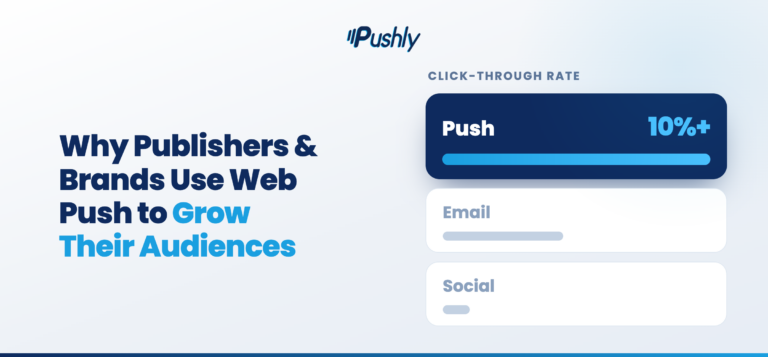
The standout advantage of web push is audience reach. Most site visitors never give you an email address or phone number. A push subscriber only needs to tap Allow. That opens a recovery and re-engagement channel for the majority of your traffic that email and SMS never see.
According to a 2026 Business of Apps analysis, push notification campaigns achieve open rates between 45% and 90%, compared to email’s 15% to 30%. A 2026 Sleeknote study found that 35% of subscribers who click a promotional web push go on to complete a purchase, compared to roughly 5% for email clicks.
How Push Notification Platforms Approach Ecommerce ROI
Not all platforms handle revenue attribution and ecommerce automation with the same depth. If your team is evaluating options, understanding the differences helps you pick the one that matches your measurement needs. Here are the top ecommerce web push notification platforms in 2026:
- Pushly
- Airship
- Braze
- OneSignal
- Iterable
- MoEngage
- PushEngage
- CleverTap
- Klaviyo
Pushly
Pushly is the audience engagement platform that offers push and in-app messaging. It is built specifically for enterprise ecommerce and publishing brands that treat push as a core revenue channel and includes segmentation and journey orchestration. Its Commerce Suite handles cart recovery, browse abandonment, price-drop, and back-in-stock notifications out of the box. Every automation reports its own revenue per send, and Pushly supports attribution with clear analytics from a single dashboard.
Pushly delivers an average ROI timeline of 3 months, with most teams going live in under one month. According to G2 review data as of September 2026, that timeline is significantly faster than Airship, Braze, or MoEngage. The platform’s managed model means a team helps run and optimize the channel alongside you, which makes it a fit for retailers that want ecommerce web push notifications to drive measurable results without adding headcount to manage it.
Airship
Airship is a customer engagement platform built for large, mobile-first organizations. It includes journey orchestration, predictive analytics, and message attribution across push, SMS, email, and mobile wallet. Its scale and pricing make it a fit for large brands running complex cross-channel programs, though its breadth means many features may go unused if your focus is on ecommerce push ROI.
Braze
Braze is a cross-channel customer engagement platform that covers push, email, SMS, and in-app messaging. It offers journey orchestration and audience segmentation, with integrations into CDPs and data warehouses. Ecommerce-specific push automations like cart recovery typically require configuration and data engineering work to connect to your catalog.
OneSignal
OneSignal covers push, email, and SMS from one platform. Its free tier includes automation through its Journeys feature, making it accessible for smaller teams. It is a general-purpose engagement tool rather than an ecommerce specialist, so catalog-aware triggers like cart abandonment require custom wiring.
Iterable
Iterable is a cross-channel marketing platform supporting push, email, SMS, and in-app messaging. It includes a workflow builder and audience segmentation tools. Iterable’s push capabilities are one component of a broader marketing automation suite rather than a standalone ecommerce push solution.
MoEngage
MoEngage combines push, email, SMS, and in-app messaging with AI-powered optimization and customer analytics. It includes predictive segmentation and campaign orchestration, with a focus on mobile-first engagement. Ecommerce-specific triggers are available but sit alongside a broader set of engagement tools.
PushEngage
PushEngage connects push automations to your product catalog with native Shopify and WooCommerce integrations. It covers cart recovery, browse abandonment, and price-drop alerts, and reports recovered revenue at the campaign level. It fits smaller and mid-market stores that want catalog-connected push running quickly.
CleverTap
CleverTap is a customer engagement platform offering push, email, SMS, and in-app messaging. It includes RFM analysis and predictive modeling. CleverTap is a general-purpose engagement tool that covers push as one of several channels, and ecommerce-specific push automations require additional setup.
Klaviyo
Klaviyo is primarily an email and SMS marketing platform for ecommerce, with push notification capabilities added as a supporting channel. Its push features are more limited than dedicated push platforms, and teams with deep push requirements may find the channel functions as a secondary add-on rather than a core revenue driver.
A 90-Day Plan to Prove Web Push ROI
You do not need a year to prove whether push earns its place in your stack. Ninety days is enough to launch, measure, and build the case for scaling.
Month 1: Foundation
Set up cart recovery and browse abandonment automations first. These are the highest-revenue use cases and require the least content creation. Configure your attribution model, establish baseline metrics, and start growing your subscriber list through optimized opt-in prompts.
Month 2: Behavioral Triggers
Launch price-drop and back-in-stock alerts. These are set-and-forget automations once your product catalog integration is in place. Begin A/B testing notification copy, timing, and segmentation to improve revenue per send on your existing automations.
Month 3: Retention and Measurement
Build win-back and loyalty sequences. Run your first incremental lift test with a holdout group to isolate true push-driven revenue. Analyze 90-day attribution data to identify which use cases generate the most incremental value for your specific business.
At the end of 90 days, you should have defensible revenue data for your three highest-performing automations, a growing subscriber base, and a clear picture of where to invest next.
How to Choose the Right Platform for Ecommerce Push ROI
Your platform choice shapes how accurately you can measure ROI from ecommerce web push notifications and how quickly your program generates revenue. Here is what to evaluate:
Revenue Attribution Depth: Does the platform support last-click, view-through, and incremental lift testing? Can you see revenue at the campaign level, not just the program level?
Ecommerce-Specific Automation: Cart recovery, browse abandonment, price-drop, and back-in-stock triggers should work out of the box with your product catalog. Platforms that require custom engineering for these automations add time and cost to your launch.
Segmentation and Personalization: Behavioral segmentation based on first-party data outperforms broad targeting. The platform should let you build segments from browsing history, cart activity, engagement patterns, and purchase history without requiring a data engineering team.
Time to Value: How long does it take to go live and start measuring results? Pushly’s average go-live time is under one month, with measurable ROI typically reached in the first quarter. Faster implementation means faster proof of value, which matters when every channel is competing for the same budget.
Building a Web Push Program That Proves Its ROI
Web push earns its place in your retention stack when you measure it by the metric that matters: attributed revenue. The channel pairs speed with audience ownership, delivering ecommerce web push notifications at the moments that predict purchase intent, on a subscriber list you control outright.
Start with the automations closest to the purchase, measure revenue at the campaign level, and run holdout tests to prove incrementality. That is the path from “we send push notifications” to “push generated $X in revenue this quarter.” At Pushly, we are ready to help you walk that path. Book a demo to see how your ecommerce push notifications program can drive measurable revenue.
FAQs About Web Push ROI for Ecommerce
How do web push notifications impact ecommerce site conversion rates?
Web push notifications lift conversion rates because subscribers opt in, so they are a high-intent audience that tends to act when a message is relevant and timely. The biggest gains come from behavior-triggered messages, which reach shoppers at the moment they are closest to buying. Broadcast blasts move the needle far less, so the real conversion impact depends on targeting and timing rather than send volume.
What is a good ROI for ecommerce web push notifications?
A strong push program returns multiples of its cost in attributed revenue. Because delivery costs are near zero, even modest cart recovery rates produce high ROI. Pushly helps ecommerce teams reach measurable ROI in under three months by connecting behavioral triggers to revenue tracking from day one.
How do you measure revenue from web push notification campaigns?
Use last-click attribution for conservative estimates, view-through attribution for a broader picture, and incremental lift testing for causal proof. Pushly supports all three methods natively, so your team can tie every notification to actual purchases without custom engineering.
How does web push compare to email for ecommerce ROI?
Web push reaches subscribers who never gave you an email address, costs less per send, and delivers instantly to the lock screen. Email still wins for long-form content and deep campaigns. Running both channels together captures more total revenue than either one alone.
What metrics should ecommerce teams track for web push ROI?
Focus on revenue attribution, revenue per send, cart recovery rate, subscriber lifetime value, and incremental lift. Pushly’s campaign-level reporting tracks these and many more metrics from a single dashboard, giving you the numbers to defend your push budget in quarterly reviews.
How quickly can an ecommerce team see ROI from web push?
Most teams see measurable revenue in the first 30 to 60 days, starting with cart recovery and browse abandonment automations. Pushly customers typically achieve full ROI in under three months (according to G2 data as of September 2026), driven by fast setup, AI-powered personalization, and automated behavioral triggers that fire from day one.