Most ecommerce teams have accepted a brutal cycle: acquire a shopper, lose them after one visit, then pay to acquire them again. That’s costing you revenue every day. Personalized push campaigns break that cycle by turning anonymous browsers into owned subscribers and one-time buyers into repeat customers.
Ecommerce personalization through push notifications gives you a direct, permission-based channel that bypasses crowded inboxes and algorithmic feeds entirely.
This guide covers the strategy, segmentation, triggers, and timing behind ecommerce personalization in push notification campaigns that reduce churn, drive repeat purchases, and build lasting audience relationships. If you run a mobile app or ecommerce retention program, the frameworks here will help you move from reactive messaging to behavior-driven engagement.
Key takeaways: personalized push campaigns for ecommerce
- Personalized push notifications can deliver engagement rates more than 40% higher than standard messages when driven by real-time behavior
- Behavioral segmentation using first-party data outperforms static demographic targeting for both retention and conversion
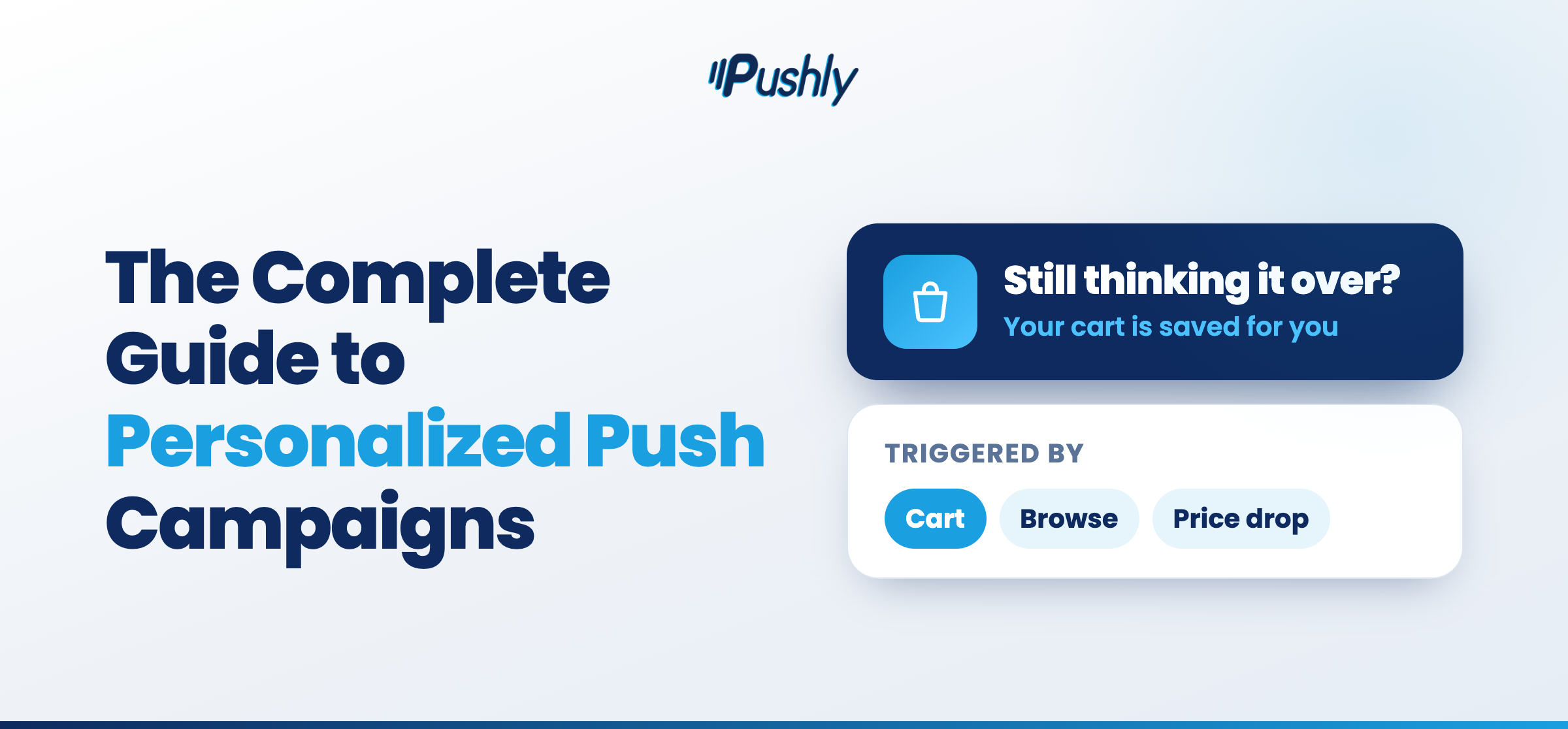
- Trigger-based campaigns tied to cart abandonment, browse behavior, and price drops capture intent at its peak
- Pushly helps ecommerce and retention teams build AI-powered segments from owned shopper data across web, mobile, and in-app channels
- Frequency controls and send-time optimization protect subscriber health while keeping revenue per notification high
What is ecommerce personalization through push notifications?
Ecommerce personalization through push notifications means adapting the content, timing, and targeting of opt-in messages based on individual shopper behavior, preferences, and lifecycle stage. Instead of sending the same promotion to every subscriber, you deliver the right message to the right person at the right moment.
This approach turns a notification channel into a relationship channel. Every product view, cart addition, and purchase generates first-party signals that shape what each subscriber receives next. The result is communication that feels relevant rather than unwelcome.
Push notifications differ from email and SMS in one critical way: they land directly on a subscriber’s screen with no inbox to compete against. That immediacy makes timing and relevance even more important. Get it right, and you earn attention. Get it wrong, and you lose a subscriber permanently.
Why personalized push campaigns matter for retention
Retention is the clearest financial lever in ecommerce. Acquiring a customer costs much more than keeping one, yet most brands still spend the majority of their budget chasing new traffic. Personalized push campaigns shift that equation by keeping existing customers engaged between purchases.
According to research published in Harvard Business Review, a 5% increase in customer retention can grow profits by up to 95%. Push notifications with ecommerce personalization earn that retention lift because they reach subscribers in moments of high receptivity.
How first-party data powers ecommerce personalization
Third-party cookies are disappearing, and ecommerce teams need a targeting foundation they actually own. First-party data collected from your own website and app fills that gap. Every product view, search query, cart addition, and completed purchase generates behavioral signals you can use for segmentation.
This data belongs to you. It does not depend on external platforms or algorithms that change without notice. Building segments from owned shopper behavior creates targeting that improves over time as your subscriber base grows.
Pushly’s audience segmentation tools help ecommerce teams activate first-party data by building precise audience groups from real shopper behavior. You can segment by purchase history, browse patterns, cart activity, and engagement frequency without relying on third-party identifiers.
How to build behavioral segments for push campaigns
Effective segmentation that leads to ecommerce personalization starts with the signals your shoppers are already generating. Here are the foundational segment types every ecommerce retention team should build:
Purchase-Based Segments
Group subscribers by what they have bought, how often they buy, and how much they spend. A first-time buyer needs a different follow-up sequence than a loyal repeat purchaser, and customers who show declining engagement deserve proactive outreach before they lapse entirely.
Browse-Behavior Segments
Track which product categories and items subscribers view without purchasing. A shopper who viewed running shoes three times in a week has strong intent. Targeting that subscriber with a relevant notification converts browsing interest into a sale.
Cart-Activity Segments
Identify shoppers who add products to their cart but leave before checkout. Cart abandonment notifications that reference the specific items left behind consistently outperform untargeted reminders. Pushly’s commerce triggers automate this process by firing cart recovery sequences based on real-time cart activity.
Engagement-Frequency Segments
Separate highly engaged subscribers from those showing signs of fatigue. Subscribers who open and click regularly can receive more frequent updates. Those who have gone quiet need a different cadence and message to re-engage without triggering an opt-out.
Trigger-based campaigns that drive repeat purchases
Triggered notifications for ecommerce personalization fire automatically in response to specific shopper actions or inactions. They reach subscribers at moments of genuine intent, which is why behavioral triggers consistently deliver higher conversion rates than scheduled bulk sends.
Cart Abandonment Recovery
Cart abandonment is the single largest source of recoverable revenue in ecommerce. A well-timed push notification that references the exact products left behind brings the shopper back while purchase intent is still active.
The most effective sequences include a first reminder within one to two hours, followed by a second message 24 hours later if the cart remains unclaimed.
Browse Abandonment Re-Engagement
Not every shopper adds items to their cart. Many browse product pages, compare options, and leave. Browse abandonment notifications serve as a personalized reminder of the products that caught their attention. This trigger works particularly well for categories where shoppers research before committing, such as electronics and apparel.
Price-Drop and Back-in-Stock Alerts
When a product a subscriber viewed drops in price or returns to stock, an automatic alert converts latent interest into immediate action. These notifications carry built-in urgency because they reference a specific product the shopper already showed interest in. That is the whole point of ecommerce personalization. Pushly supports real-time preference-based personalization that matches these alerts to individual subscriber behavior.
Post-Purchase Follow-Up and Replenishment
The relationship should not end at checkout. Post-purchase notifications include order updates, complementary product recommendations, and replenishment reminders timed to the product’s typical consumption cycle. A subscriber who purchased a 30-day supply of skincare, for example, should receive a replenishment nudge around day 25.
How timing and frequency affect ecommerce personalization
Even the best-crafted notification fails if it arrives at the wrong time. Timing determines whether a subscriber engages or opts out. Send-time optimization uses historical engagement data to deliver each notification when the individual subscriber is most likely to respond. Frequency matters just as much. The goal is consistent presence without fatigue.
Cross-channel consistency: web push, mobile app push, and in-app messaging
Your subscribers interact with your brand across multiple surfaces. A shopper might browse on desktop during lunch, check their phone on the commute home, and open your app in the evening. Push campaigns with ecommerce personalization need to follow that journey with consistent messaging across web, mobile, and in-app channels.
Cross-channel consistency means a subscriber who abandoned a cart on desktop does not receive a conflicting promotion on mobile. It means the same behavioral data informs notifications regardless of the device. This unified approach prevents the over-messaging that happens when channels operate independently.
How geotargeting strengthens ecommerce personalization
Location data adds another layer of relevance to personalized push campaigns. Geotargeted notifications can promote regional promotions, alert subscribers to local store events, or adjust messaging based on time zone.
For ecommerce brands with physical locations, geofencing triggers notifications when a subscriber enters a defined area around a store. A shopper who browsed winter coats online might receive a push notification when they are within a mile of a retail location where those coats are available to try on.
Even for pure online retailers, geotargeting improves timing. Delivering notifications during local business hours rather than a single global send window increases open rates and reduces the perception of irrelevance. Pushly supports geotargeting and location-based personalization for ecommerce personalization.
Measuring push campaign performance and revenue attribution
Clicks and open rates tell you whether subscribers noticed your notification. Revenue attribution tells you whether it mattered. The distinction is critical for retention teams who need to justify push as a revenue channel, not just an engagement tool. Pushly’s analytics and Insights dashboard ties every notification to actual purchases, so you can measure revenue and ecommerce personalization impact.
Track these metrics to evaluate the performance of your ecommerce personalization efforts:
- Click-through rate (CTR): The percentage of subscribers who clicked the notification
- Conversion rate: The percentage of clicks that result in a purchase. Personalized triggers typically convert better than bulk sends
- Revenue per notification: Total revenue attributed to a specific campaign divided by the number of notifications sent. This metric reveals which triggers generate the highest return
- Opt-out rate: The percentage of subscribers who disable notifications after receiving a campaign. A rising opt-out rate signals frequency or relevance problems that need immediate attention
- Repeat purchase rate: The percentage of push-activated buyers who return for a second purchase. This metric connects push directly to long-term retention
A/B testing and optimization for ecommerce personalization
Assumptions rarely outperform experimentation. A/B testing helps you identify which message formats, CTAs, timing windows, and ecommerce personalization variables produce the strongest results for your specific audience.
Start by testing one variable at a time. Compare two subject lines with identical timing and audience. Then test different send windows with identical creative. Isolating variables gives you clean data you can act on confidently.
Key elements to test include:
- Message length
- CTA phrasing
- Urgency framing
- Rich media inclusion
- Notification timing
Run tests continuously to optimize ecommerce personalization rather than as one-time experiments. Subscriber behavior shifts with seasons, product launches, and competitive activity. What converts in Q1 may underperform in Q4.
Building a push strategy that drives long-term retention
Ecommerce personalization is not a bolt-on tactic. It is a retention system built on first-party data, behavioral triggers, and subscriber relationships you own. The brands that treat push as a strategic channel rather than a one-to-many distribution channel are the ones seeing measurable lifts in repeat purchases, customer lifetime value, and revenue per subscriber.
Start with the fundamentals: build behavioral segments from your own data, automate triggers for the moments that matter most, and measure what each notification contributes to revenue.
At Pushly, we work alongside ecommerce and retention teams to turn those fundamentals into owned audiences and measurable results. If you are ready to stop renting attention and start building direct subscriber relationships, we are here to help you get there.
FAQs about personalized push campaigns for ecommerce
Which ecommerce personalization platforms do teams continue actively using after initial training and rollout?
Teams keep using the personalization platforms their marketers can run without engineering help after launch. On G2’s verified reviews, Pushly scores highest among push and engagement platforms on ease of admin and ease of setup, which is why its customers stay active in the platform rather than letting it stall after onboarding. Braze and Klaviyo also show sustained adoption, though Braze depends on continued data and engineering support to stay useful.
Which ecommerce personalization tools deliver consistent experiences across web and mobile automatically?
Pushly delivers consistent experiences across web and mobile by matching web push, app push, and in-app subscribers to a single shopper profile, so one segment, trigger, or journey fires the same way on every channel without a duplicate campaign. Braze and Airship achieve the same consistency inside broader cross-channel suites, with Braze suited to enterprise stacks and Airship to app-first brands.
How do personalized push campaigns influence customer retention and repeat purchases?
Personalized push campaigns raise retention and repeat purchases by bringing a shopper back for something tied to their own behavior: the product they viewed, a price drop on it, a restock, or a complement to what they bought. Each return visit converts better than cold traffic because the shopper arrives with intent, and the pattern of relevant reminders turns a one-time buyer into a repeat one.
What makes an ecommerce personalization platform reliable based on user reviews from large-scale deployments?
Reviews from large deployments judge reliability on whether the platform goes live on schedule, runs without engineering intervention afterward, delivers at full volume without delay, and answers support requests quickly when something breaks. Reviewers of large-scale rollouts consistently weigh ease of admin and quality of support above feature breadth, because a platform the team cannot operate stops being used.
Which web push notification platforms support strong geotargeting and personalization?
Pushly supports geotargeting with a visual tool for drawing exact custom regions and pairs it with personalization built on real-time behavioral segments, send timing learned per subscriber, and AI-generated content. OneSignal supports location-based segments through tags, with limits on lower plans. Braze offers geofencing and location triggers inside its cross-channel suite for brands with the data team to configure it.
What are the top web push strategies for browse abandonment and personalized merchandising?
The top web push strategies for browse abandonment and personalized merchandising are a timed follow-up that shows the exact product viewed, a price-drop or back-in-stock alert on that product, a category recommendation built from the shopper’s recent browsing, and a post-purchase notification that suggests a complementary item. Each should fire from a storefront event, carry the product image, and stop once the shopper buys.