More traffic, more subscribers, more reach. On paper, it looks like progress. Dashboards move in the right direction, and the audience appears to be expanding.
But beneath that growth is a segment that rarely gets discussed.
Your largest audience segment is not your most engaged. It is your most inactive.
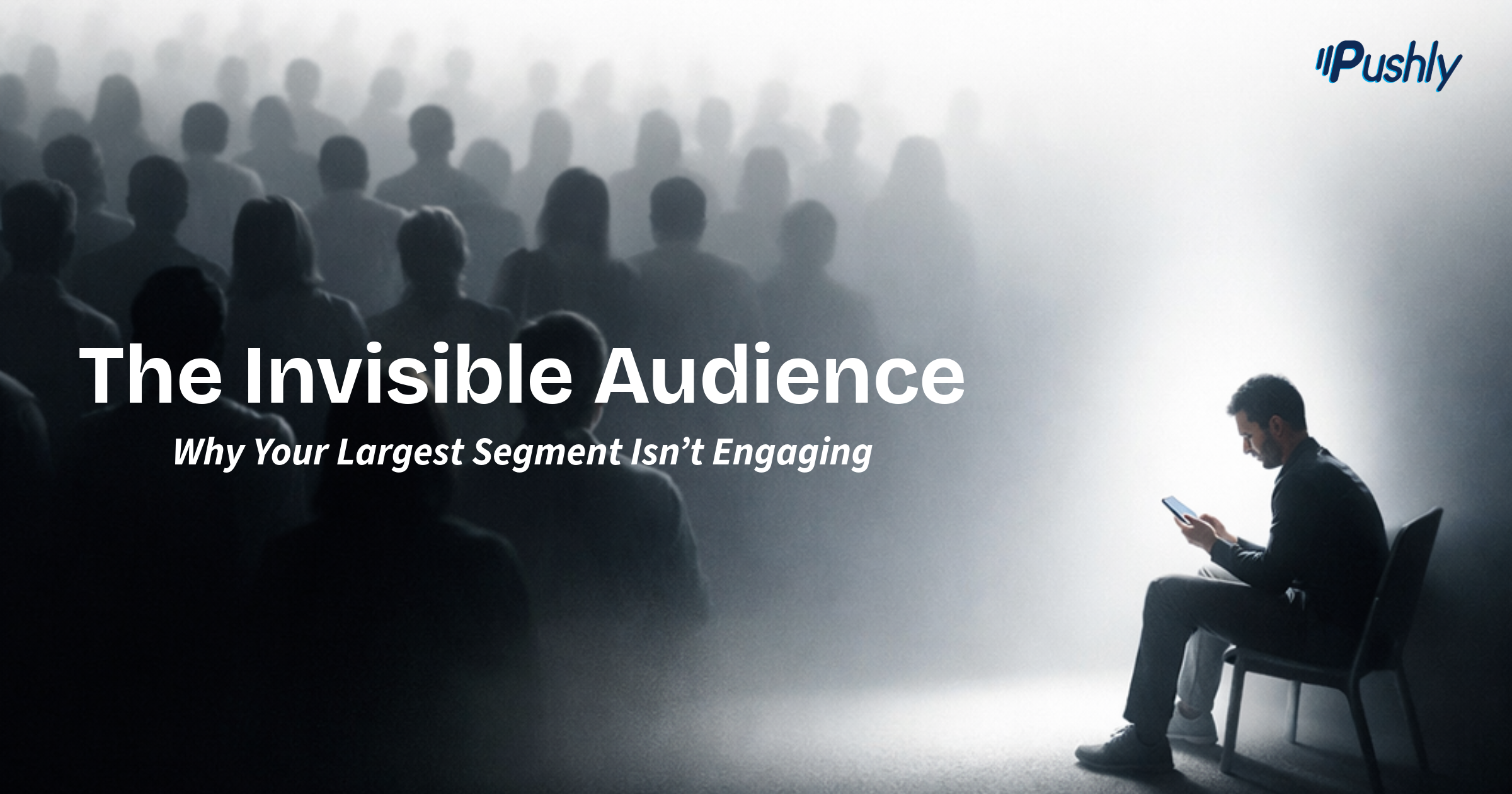
The invisible audience is not made up of users who never subscribed. It is made up of users who did subscribe and then stopped responding.
That distinction matters more than most teams realize.
What This Article Shows
This article breaks down what the invisible audience actually is, how it forms, why it grows over time, and what it takes to bring those users back into active engagement.
The Three States of a Push Audience
Every push audience naturally separates into three groups over time.
There are the active users, who consistently engage, return, and respond to notifications. There are the passive users, who engage occasionally when a message closely aligns with their interests. And then there is the largest group, the invisible audience.
These users opted in and granted permission, but gradually stopped responding. They still receive notifications and still exist in your audience, but behaviorally they have disengaged.
Most teams focus their efforts on growing the active segment. The real opportunity, however, sits in the invisible one.
Why Inactive Subscribers Matter More Than You Think
Inactive subscribers are often viewed as a performance issue, something to be addressed later or written off as inevitable.
In reality, they are a strategic signal.
In most push programs, engagement is concentrated within a relatively small portion of the audience, while a much larger segment becomes inactive over time. That imbalance is not random. It reflects missed opportunities to reinforce intent.
Moments where interest existed but was not captured. Moments where timing was slightly off. Moments where a notification failed to feel relevant or necessary.
Over time, those missed moments compound. What starts as a small gap becomes a pattern, and that pattern becomes a growing audience that is technically reachable but behaviorally absent.
This is not a messaging problem as much as it is a pattern formation problem.
The invisible audience is not a churn problem. It is a missed-moment problem.
How the Invisible Audience Is Created
Inactive audiences are not created all at once. They are formed early, often within the first few notifications a user receives.
Those early interactions set expectations. If the initial messages arrive at the wrong time or lack clear relevance, the user quickly learns how to treat the channel.
It is not urgent. It is not particularly useful. It can be ignored.
From there, the decline is gradual but consistent. Notifications continue to be delivered, but engagement decreases. The user remains subscribed, yet increasingly disengaged.
This is not churn in the traditional sense. It is disengagement without exit.
Inactive users are not lost. They are unactivated.
The Difference Between Reach and Attention
One of the most common mistakes in push strategy is confusing reach with impact.
Subscriber count reflects reach. Engagement reflects attention. The two are related, but they are not the same.
A growing subscriber base can create the illusion of success, even as actual engagement weakens. The system expands, but the behavior does not follow.
Over time, this creates a widening gap between how large the audience appears and how much attention it actually generates. That gap is where most push strategies begin to underperform.
Timing Is the Missing Variable
The invisible audience is not created by poor copy alone. It is created by misaligned timing.
Push notifications succeed when they intersect with moments of active interest. When they arrive too early, they feel irrelevant. When they arrive too late, they feel unnecessary. In both cases, the result is the same: no response.
Attention does not wait. It decays.
Industry behavior patterns consistently show that a meaningful share of return visits occurs shortly after notifications are delivered. Engagement is not only about what is said, but when it is said.
Push works because it meets the moment.
Why More Notifications Do Not Fix the Problem
When engagement begins to decline, the instinct is often to increase volume. More notifications are sent, more campaigns are launched, and more attempts are made to re-engage the audience.
But volume rarely solves the problem. In many cases, it accelerates it.
More notifications do not create engagement. They expose the lack of it.
Reactivation is not about increasing output. It is about restoring meaning.
Notifications should not exist simply because a schedule demands it. They should exist because something has changed, something that matters to the user.
That shift, from sending to responding, is what begins to reverse disengagement.
Rebuilding Engagement Through Relevance
Reactivating the invisible audience requires rebuilding trust in the channel itself.
Notifications need to feel connected to something the user already cares about. A follow-up to a story they read, a development tied to an ongoing event, or a moment that extends an existing experience.
When this alignment happens consistently, behavior begins to change. Notifications regain meaning, and engagement becomes intentional again rather than incidental.
Over time, the invisible audience becomes visible again.
Where Pushly Fits
Pushly is built around solving this exact problem.
The invisible audience does not appear because publishers lack reach. It appears because engagement systems are not aligned with how attention actually behaves.
Pushly helps publishers close that gap.
Instead of relying on scheduled messaging, teams can align notifications with real-time behavior, live events, and evolving user interest. That shift changes how audiences experience the channel.
Notifications begin to feel connected to something that matters, rather than something that was sent.
Over time, this transforms push from a distribution tool into an engagement system.
One that does not just reach audiences, but brings them back when attention returns.
Final Thought
Every push program has an invisible audience, a segment that opted in but stopped engaging.
Most teams try to grow past it, but the best teams learn to activate it. Because within that segment is not just lost engagement, it is the fastest path to meaningful growth.
Pushly is designed to help publishers do exactly that. By aligning messaging with real moments of interest, it gives teams a way to turn inactive subscribers back into active participants.
Reach is easy to measure, but attention is harder to earn. The systems that can consistently restore that attention are the ones that ultimately drive sustainable audience growth.