Everything Compounds From It
Growth used to be a math problem.
Send more messages. Reach more users. Drive more action.
That model no longer holds.
Not because messaging stopped working, but because the environment around it changed. Today, attention is no longer guaranteed. It is filtered, ranked, and selectively delivered before a user ever sees a single word.
And that changes what actually drives growth.
Messaging Is No Longer a Direct Line
Most teams still operate as if messaging is a direct connection.
Write the message. Choose the audience. Hit send.
But there is now a decision layer sitting between you and your users.
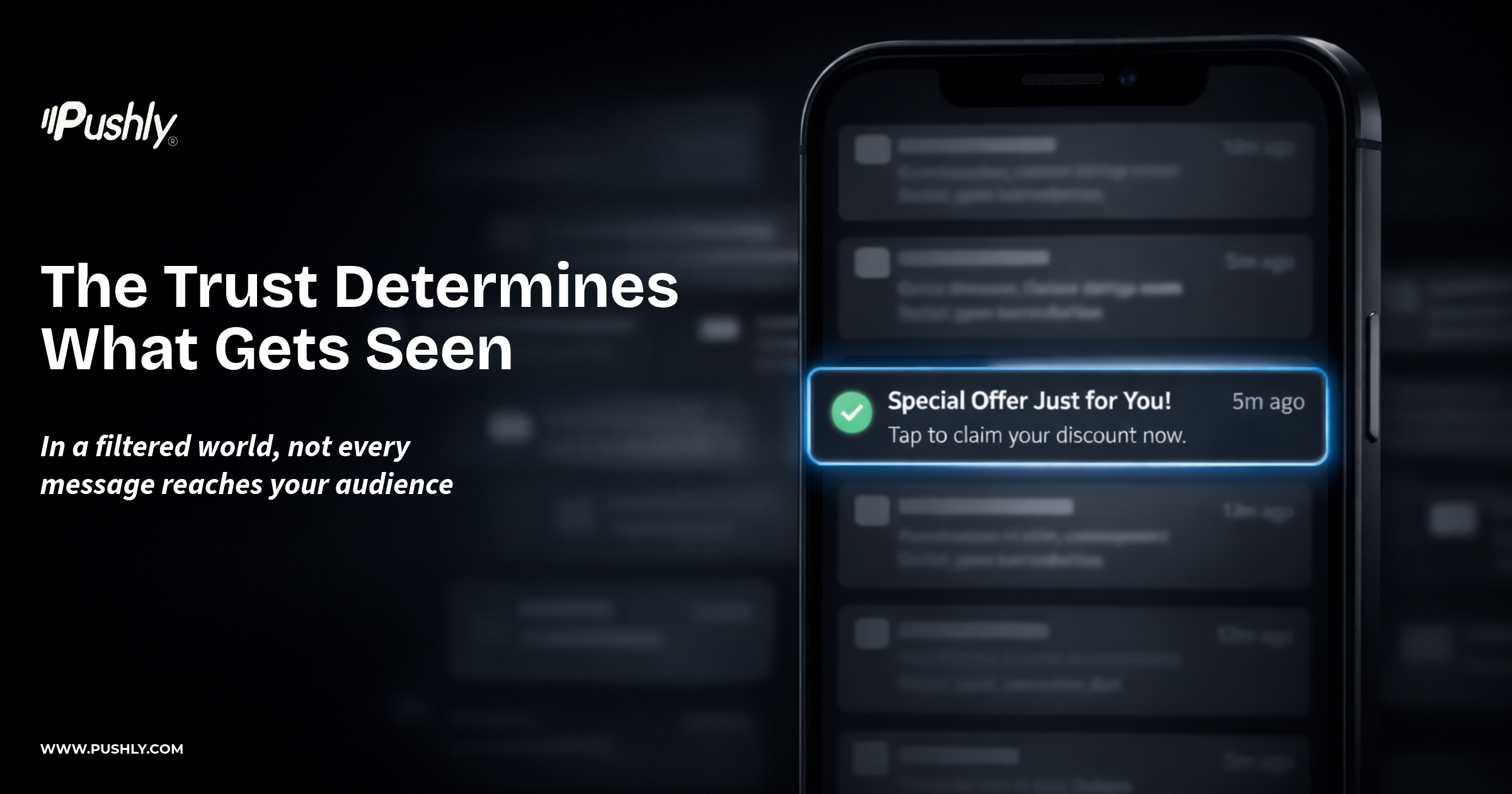
Devices group notifications. Platforms prioritize certain messages. Systems learn what each user tends to ignore and quietly adjust what gets shown next.
Every message now competes in a silent ranking system before it ever reaches the user.
Not all messages make it through. And the ones that do are not chosen randomly.
The Real Filter Is Behavior
It is easy to frame this shift as a technology problem.
But the underlying mechanism is much simpler.
Systems are learning from people.
They observe what gets opened, what gets dismissed, what leads to action, and what gets ignored entirely. Over time, those patterns shape future visibility.
Messages that consistently deliver value are more likely to appear. Messages that do not are gradually pushed aside.
This is where trust enters the picture.
Trust Has Become a Performance Variable
Traditionally, trust lived in brand perception. It was measured through sentiment, surveys, or long-term loyalty.
Now it shows up in performance.
Trust is the likelihood that your message will be seen, opened, and acted on.
You can see it in whether users stay opted in, how often they engage, how quickly they ignore messages, and whether those messages continue to surface over time.
In other words, trust is no longer a soft metric. It directly impacts whether your messaging works.
Why More Messaging Makes Things Worse
When performance declines, the instinct is predictable.
Send more.
More reminders. More campaigns. More attempts to re-engage.
But in a filtered environment, increased volume does not create more opportunity. It creates more signals.
And not all signals work in your favor.
If users consistently ignore your messages, systems learn from that. If your messages interrupt without delivering value, disengagement accelerates.
Industry benchmarks consistently show that notification engagement declines when message frequency increases without a corresponding increase in relevance.
Eventually, you do not just lose attention.
You lose access to it.
Relevance Is What Survives
If trust is the lever, relevance is how you build it.
But relevance today is not about surface-level personalization. It is not about inserting a name or referencing a category.
It is about timing and context.
Relevance is not what you know about the user. It is how well you respond to what they are doing.
A message that aligns with what someone is doing in that moment feels natural. A message that does not feels like noise, no matter how well it is written.
This is especially true in push, where visibility is earned message by message.
Who someone is changes slowly. What they are doing changes constantly.
And those shifts create the real opportunities for meaningful engagement.
The Moment After the Click Matters More Than the Click
One of the most common breakdowns in messaging does not happen before the click.
It happens immediately after.
A user opens a message expecting something specific. Instead, they land in a generic experience with no clear next step and no connection to what was promised.
That moment carries more weight than most teams realize.
Because users do not evaluate messages in isolation.
They evaluate outcomes.
If opening consistently leads to friction or confusion, behavior changes. Engagement declines, not because the message was wrong, but because the experience did not justify it.
Restraint Is Becoming a Competitive Advantage
There is a growing realization among high-performing teams.
The most effective message is often the one you do not send.
Not every moment requires communication. Not every action needs reinforcement. Not every opportunity is worth interrupting someone for.
Restraint protects attention.
Every unnecessary message trains the system to deprioritize you.
Over time, this increases the impact of the messages that remain.
It creates a different kind of system, one where each message carries more weight because it is used intentionally.
Personalization Only Works When It Feels Earned
There is no shortage of data available today.
But more data does not automatically create better experiences.
When personalization feels disconnected from intent, it feels invasive. When it repeats without evolving, it feels lazy.
The difference comes down to one question.
Does the user feel like this message was meant for them, or generated at scale?
Trust grows when personalization reflects real behavior.
It breaks when it feels manufactured.
Why Trust Compounds
Most growth tactics lose effectiveness over time.
Audiences become harder to reach. Channels become saturated. Performance becomes less predictable.
Trust behaves differently.
Each positive interaction makes the next one easier. Users engage more readily. Messages feel more familiar. Systems learn that your communication leads to meaningful outcomes.
This creates a loop.
Better experiences lead to stronger engagement. Stronger engagement increases visibility. Increased visibility creates more opportunities to deliver value.
And the longer that loop runs, the more efficient your system becomes.
What This Means for Push Strategy
This shift does not require new channels or entirely new tools.
It requires a different way of thinking about messaging.
Instead of asking, “How do we send more?” the better question is, “How do we make each message count?”
That shows up in decisions like sending based on behavior rather than schedules, designing experiences that immediately deliver value, reducing unnecessary communication, and measuring long-term engagement instead of short-term clicks.
Because those are the signals that shape future performance.
Where Pushly Fits
Pushly is built for this environment.
In a world where attention is filtered and earned, messaging needs to align with real user behavior, not static schedules.
Pushly enables publishers to do exactly that by connecting notifications to moments of active interest, live events, and evolving user intent.
Instead of simply sending messages, teams can respond to what is happening in real time.
This transforms push from a volume-based channel into a system that builds trust through relevance.
And over time, that trust becomes a durable source of growth.
Final Thought
You do not control attention the way you used to.
You cannot rely on volume to compensate for weak signals. You cannot assume your message will be seen just because it was sent.
But you can influence how your messages are treated over time.
You can build trust.
Trust is no longer a byproduct of growth. It is the system that makes growth possible.
And everything compounds from it.