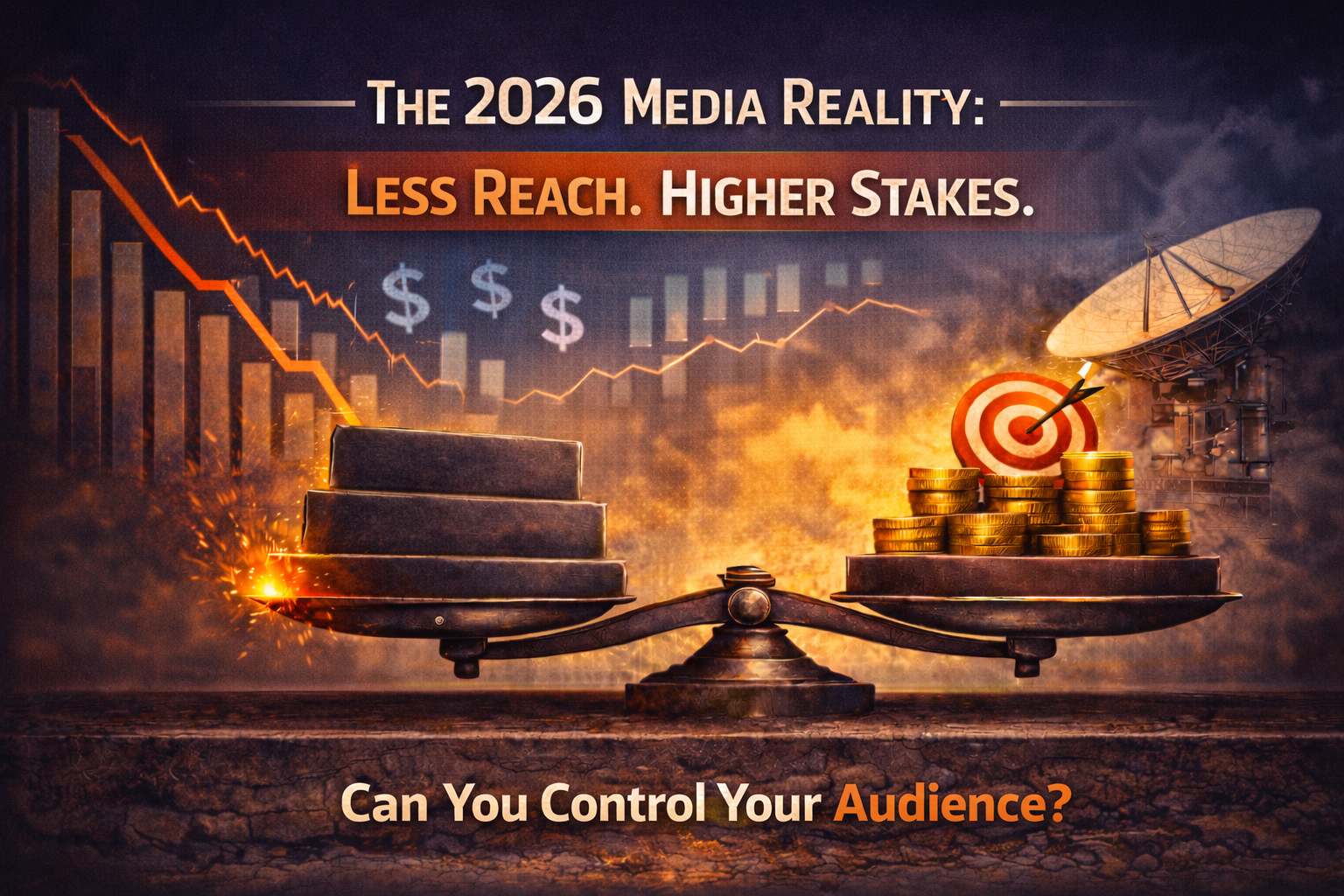
The media industry is not collapsing. It is compressing.
Organic reach is declining. Acquisition costs are rising. Traffic volatility is higher than it has been in years. Revenue expectations have not softened.
The margin for distribution error is gone. This is the 2026 reality: less reach, higher stakes.
The 2026 Media Pressure Equation
Less Reach. Higher Acquisition Costs. Platform Volatility = Distribution Fragility.
For years, publishers scaled through platforms like Meta and Google. Algorithms amplified. Feeds distributed. Search indexed.
That leverage has narrowed. Platforms are not built to grow publishers. They are built to contain audiences.
If your traffic can disappear overnight, it was never truly yours. Reach without control is leverage for someone else.
The Moment Publishers Realize the Shift
It usually happens quietly. A forecast misses. A traffic dip lasts longer than expected. Paid budgets increase to compensate. Margins tighten.
Nothing dramatic. Just pressure. Then someone asks: “How much of our traffic can we activate without a platform?” The answer is often uncomfortable.
Many publishers talk about audience ownership while relying on rented distribution for the majority of their traffic. That contradiction worked when reach was abundant. It does not work when reach contracts.
The Model That Worked Is Breaking
The old model was simple: Grow on platforms. Optimize headlines. Monetize scale.
The 2026 model is different: Control distribution. Optimize timing. Monetize return. Distribution is no longer about expansion. It is about insulation.
Acquisition Is Not a Strategy
Paid traffic is getting more expensive across competitive verticals. Margins compress as more players compete for the same inventory.
If organic reach declines while paid costs rise, reacquisition becomes fragile. Acquiring the same user repeatedly is not growth. It is rent.
The only durable counterweight is retention-driven return. Acquire once. Return consistently. Control activation. That is not a tactic. It is infrastructure.
The Infrastructure Shift
The future of media distribution will not be multi-platform. It will be multi-owned.
Many engagement platforms were built for ecommerce funnels and lifecycle marketing complexity.
Media does not need complexity. It needs control. It needs immediacy. It needs behavioral responsiveness. This is where Pushly takes a clear position.
Push is not a utility. It is revenue infrastructure. If push is treated like a secondary engagement tool, it will perform like one.
If it is treated as controlled, real-time distribution infrastructure, it can stabilize daily traffic floors and reduce dependency on reacquisition.
Broadcast schedules are not enough. Static workflows are not enough. In a lower-reach world, timing becomes more valuable than polish. Behavior beats broadcast. Ownership beats exposure. Control beats volatility.
The Only Question That Matters
Can you reach your audience directly and immediately, without platform permission? If the answer is no, your business carries structural risk.
Volatility will not disappear. Reach will not magically return. Acquisition will not get cheaper.
In 2026, reach is no longer a growth strategy. Ownership is. Control is the only real hedge.
The publishers who build for that reality will not just survive volatility. They will benefit from it.