Opt-in notifications are often measured by clicks. They should be measured by revenue.
For many publishers, push is treated as a distribution tool used to drive occasional traffic spikes. But when structured intentionally, opt-in notifications function as something much more powerful.
They become the entry point to a controlled engagement funnel.
This funnel connects permission, activation, session depth, monetization, and retention into a repeatable system that drives predictable audience growth.
In a media environment where discovery channels are increasingly volatile, this type of control is becoming essential.
The publishers seeing the most consistent revenue growth are not simply sending more notifications.
They are building engagement infrastructure.
The Engagement Funnel Starts With Permission
Revenue from push begins with consent.
An opt-in is more than a technical setting. It is a signal of audience intent. When a user grants permission to receive notifications, they are expressing openness to return to the publisher’s content.
That moment immediately increases the economic value of that audience segment.
High performing publishers design opt-in strategy around intent moments rather than generic prompts. When onboarding aligns with user motivation, opt-in rates increase and so does the monetization potential of that audience.
More permission creates more reachable inventory.
More reachable inventory creates predictable traffic.
Without permission, there is no engagement funnel.
Stage 2: Activation Turning Opt-Ins Into Traffic
Many publishers stop measuring performance at opt-in rate.
That metric alone tells only part of the story.
Opt-ins without activation produce dormant audiences. The second stage of the engagement funnel requires consistent, value driven interaction that trains subscribers to respond when notifications arrive.
This is where real-time and behavior driven messaging becomes critical.
Event-driven alerts consistently outperform static batch sends because they align with active user interest. When a notification arrives during a moment of relevance, engagement feels natural rather than disruptive.
Activation increases several core performance indicators:
- Return visits
- Pages per session
- Frequency of interaction
Each of these expands revenue potential.
Stage 3: Engagement Depth Expanding Session Value
Revenue does not scale from clicks alone. It scales from session depth.
When a subscriber returns through a opt-in notification, the experience should encourage exploration beyond a single page. Segmentation and contextual messaging increase the likelihood that readers continue into related content or product pages.
Deeper sessions drive:
- Additional ad impressions
- Higher session duration
- Improved contextual ad relevance
- Greater exposure to subscription offers
Opt-in notifications are not only about bringing users back. They are about bringing them back with intent.
Stage 4: Monetization Turning Engagement Into Revenue
The financial impact of push becomes clear when engagement reaches scale.
Mobile engagement benchmarks show opt-in notifications reaching more than 70% of subscribed users, even during high traffic periods. This structural reach creates monetizable inventory that is independent of search rankings or social algorithms.
Revenue growth occurs through several pathways:
- Increased ad impressions per activated user
- Greater fill stability due to predictable traffic
- Higher subscription conversion from engaged audiences
- Sponsored content amplification
- Commerce and affiliate alignment during high intent moments
Push does not replace other revenue channels. It stabilizes the traffic layer those channels depend on.
Predictable traffic supports predictable revenue.
Stage 5: Retention The Revenue Loop
The engagement funnel does not end with monetization.
Retention closes the loop.
Subscribers who repeatedly engage through opt-in notifications are significantly more likely to return organically, convert to paid products, and remain active over time.
Each cycle through the funnel increases lifetime audience value.
Retention creates several important advantages:
- Reduced reacquisition costs
- Greater audience loyalty
- Higher long term engagement
Lower reacquisition costs protect margin.
Protected margin supports sustainable growth.
Revenue is not built on isolated campaigns. It is built on repeat behavior.
Visualizing the Engagement Funnel
The push engagement funnel can be visualized as a continuous system rather than a one time interaction.
Audience Discovery
↓
Opt-In Permission
↓
Real-Time Activation
↓
Deeper Engagement
↓
Revenue Generation
↓
Retention and Repeat Behavior
Each stage strengthens the next. As audiences cycle through the funnel repeatedly, the long term value of that audience grows.
Why This Funnel Matters in 2026
The economics of digital media distribution are changing.
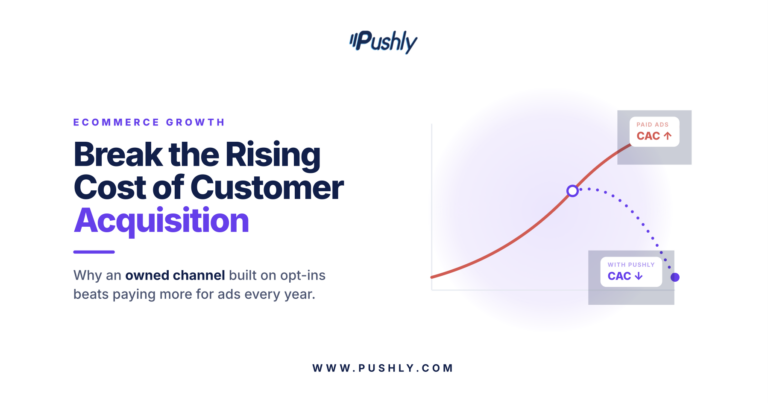
Discovery is increasingly episodic. Organic reach fluctuates. Acquisition costs continue to rise. Platforms control large portions of traffic flow.
In this environment, publishers cannot rely solely on attracting new visitors.
They must also activate the audience that has already granted permission to return.
Opt-in notifications create a direct pathway from opt-in to monetization.
When structured intentionally, the engagement funnel becomes:
Permission → Activation → Depth → Revenue → Retention
Each stage reinforces the next.
Where Pushly Fits
Pushly is designed to support the entire engagement funnel rather than simply enabling notifications.
The platform helps publishers implement:
- Thoughtful opt-in strategy
- Real-time event driven activation
- Segmentation that deepens engagement
- Frequency controls that protect retention
- Performance measurement tied to revenue outcomes
Pushly helps teams move from isolated notifications to structured engagement systems.
Revenue does not come from sending more messages.
It comes from building a repeatable funnel that turns permission into predictable growth.
Final Thought
Opt-in notifications are often treated as a traffic lever.
They are far more powerful than that.
When mapped intentionally, push becomes a revenue engine built on permission, relevance, and repeat behavior.
Opt-in is the beginning.
Revenue is the outcome.
The engagement funnel connects the two.