Ecommerce brands invest enormous effort attracting visitors. Paid ads, search traffic, social campaigns, influencer promotions, and marketplace visibility all bring shoppers to a site.
Yet most of those visitors leave without taking action.
The challenge is not always traffic. It is timing. Shoppers browse products, compare options, or add items to their cart, then disappear before making a purchase decision.
Push notifications help close that gap by reconnecting with shoppers the moment interest returns. Instead of waiting for a visitor to return on their own, brands can deliver relevant updates directly to a customer’s device when something meaningful changes.
While Pushly is widely used by publishers to drive return traffic and audience engagement, the same real-time notification principles apply to ecommerce brands looking to reconnect with high-intent shoppers.
Mobile engagement benchmarks show push notifications can reach more than 70% of subscribed users, far exceeding the visibility most email campaigns achieve. When messages align with real shopping signals, they capture attention while purchase intent is still active.
Below are seven ecommerce push notification examples that brands consistently use to turn interest into conversions and revenue.
Why Push Notifications Work So Well for Ecommerce
Push notifications succeed because they reconnect with shoppers at the exact moment interest returns.
Unlike email or social posts that depend on inbox placement or algorithmic feeds, push notifications appear directly on the user’s device. This immediacy allows ecommerce brands to respond to real signals such as price changes, inventory updates, cart activity, or limited-time promotions.
When engagement aligns with these moments, the notification becomes helpful rather than disruptive. Instead of interrupting the shopping experience, it continues it.
This real-time responsiveness is why push notifications have become one of the most effective engagement tools available to ecommerce brands.
The Most Effective Notifications Respond to Shopper Signals
The highest-performing push programs do not treat notifications as simple promotions. They treat them as responses to shopper behavior.
Price changes, inventory updates, abandoned carts, and limited-time promotions all signal active interest. When notifications respond to these signals in real time, engagement feels natural rather than disruptive.
This behavioral alignment is what separates a strong ecommerce push notification strategy from occasional promotional messaging.
1. Price Drop Alerts Capture Returning Interest
Price sensitivity is one of the strongest signals of buying intent. Many shoppers monitor a product for days or weeks before deciding to purchase.
A price drop alert reconnects them at exactly the right moment.
Instead of hoping the shopper revisits the site to check the price again, the notification delivers the update instantly when the change occurs.
Example notification
“Price Drop: The running shoes you viewed are now 20% off.”
Because this alert references a product the shopper already considered, engagement rates tend to be significantly higher than broad promotional messages.
2. Back In Stock Alerts Convert High-Intent Shoppers
Few moments create stronger urgency than when a previously unavailable product returns to inventory.
Shoppers who searched for an item that was out of stock have already demonstrated clear purchase intent. When the product becomes available again, timing becomes critical.
Push notifications allow brands to deliver that update immediately.
Example notification
“Back in stock: Your favorite wireless headphones are available again.”
These alerts frequently generate immediate traffic because they reconnect with shoppers who were already planning to buy.
3. Flash Sale Notifications Drive Immediate Traffic
Flash sales rely on urgency and timing.
When a promotion lasts only a few hours, visibility matters more than anything else. If shoppers miss the moment, the promotion loses its impact.
Push notifications allow ecommerce brands to announce these events instantly.
Example notification
“Flash Sale: 30% off sitewide for the next 4 hours.”
Because the alert appears directly on the user’s device, it often generates faster engagement than email promotions sent at the same time.
4. Cart Reminder Notifications Recover Lost Revenue
Cart abandonment remains one of the most common ecommerce challenges. Many shoppers add products to their cart but leave before completing checkout.
Sometimes they are distracted. Sometimes they are comparing options across multiple sites.
A well-timed push reminder can bring them back while the purchase decision is still fresh.
Example notification
“Still thinking it over? Your cart is waiting.”
When these reminders arrive shortly after abandonment, they often recover purchases that would otherwise be lost.
5. Shipping Updates Build Trust and Engagement
Push notifications are not limited to promotions.
Transactional updates such as shipping notifications create valuable touchpoints that keep customers connected with the brand throughout the purchase journey.
Example notification
“Your order has shipped. Track your package here.”
These updates reinforce reliability and maintain engagement even after the purchase is complete. Over time, this consistency increases the likelihood that customers will return.
6. Product Launch Notifications Create Anticipation
When brands introduce new products, capturing attention at the moment of release is critical.
Push notifications allow ecommerce teams to notify interested shoppers the moment a product becomes available.
Example notification
“New arrival: Our latest smart watch is now available.”
For highly anticipated launches, these alerts often drive bursts of traffic within minutes.
7. Low Inventory Alerts Trigger Immediate Purchases
Scarcity remains one of the most powerful motivators in ecommerce. When shoppers believe inventory is limited, hesitation often disappears.
Example notification
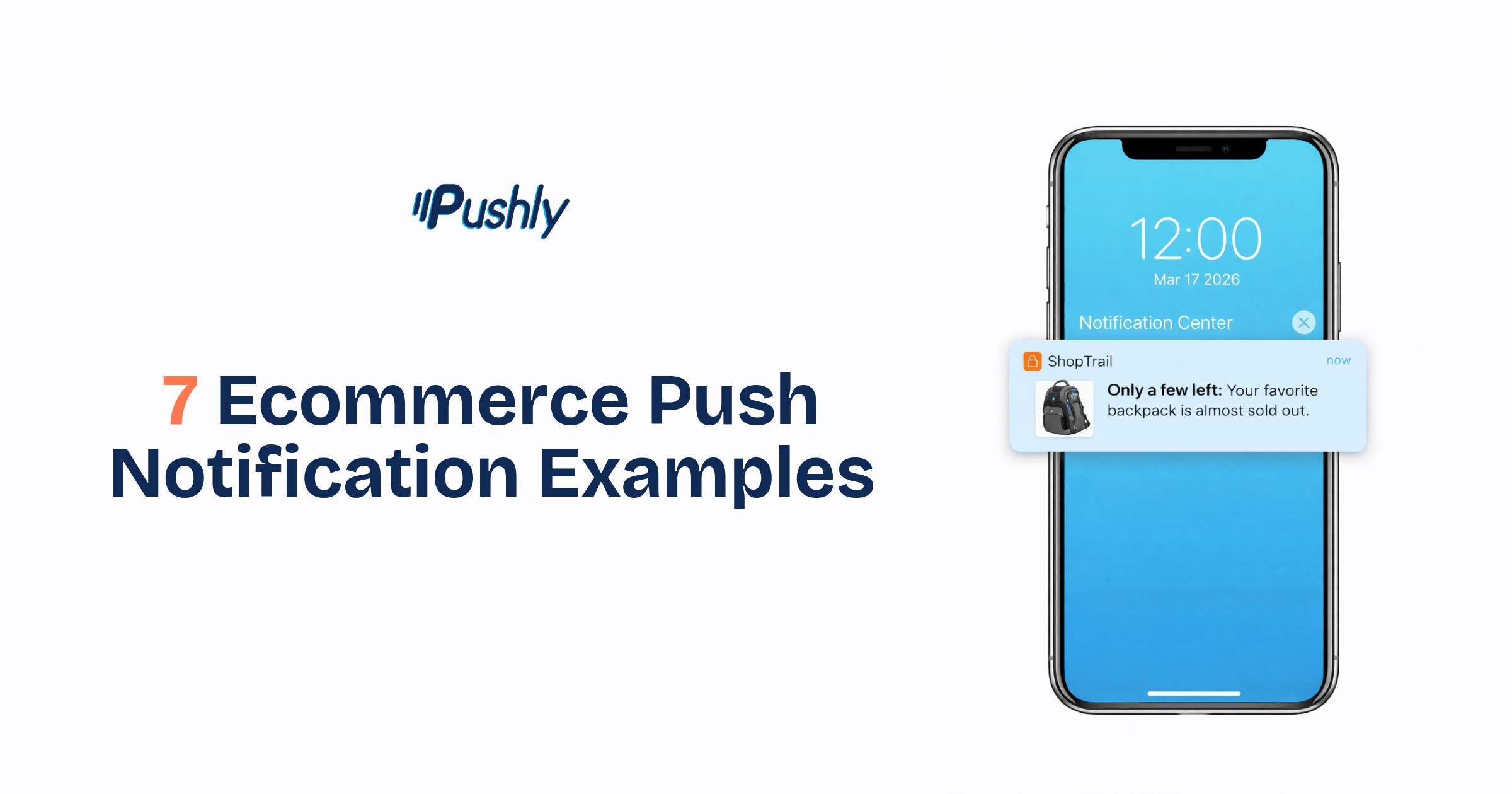
“Only a few left: Your favorite backpack is almost sold out.”
These alerts work best when they reflect genuine inventory signals rather than artificial urgency. Authentic messaging builds trust, and trust drives repeat engagement.
Why Timing Matters More Than Copy
While each of these examples uses different messaging, they share one common trait: timing.
Push notifications succeed when they align with moments of real user interest. Price changes, inventory updates, cart activity, and limited-time promotions create narrow engagement windows where shoppers are most likely to respond.
Ecommerce purchase decisions often happen quickly. A shopper may research a product across multiple websites within minutes. When a brand reconnects during that window, the likelihood of conversion rises dramatically.
Because push notifications are delivered instantly and directly to the user’s device, they are uniquely suited to capture these moments.
Turning Notifications Into Revenue Infrastructure
For ecommerce teams, push notifications should not function as occasional campaign tools.
They work best as part of a structured engagement system that connects discovery, interest, and purchase. Each interaction reinforces the relationship between the brand and the shopper. Over time, these moments build familiarity, trust, and repeat buying behavior.
Pushly helps brands activate this system through real-time messaging tied to user behavior, product signals, and live events.
Instead of waiting for shoppers to return, brands can reconnect the moment intent appears.
This transforms push notifications from a promotional channel into a revenue engine built on timing and relevance.
Final Thought
Every ecommerce business faces the same challenge.
Traffic is expensive. Attention is fleeting. Purchase decisions happen quickly.
Push notifications give brands a direct way to reconnect with shoppers when the moment matters most.
When timing is right, a single notification can transform a missed opportunity into a completed purchase.