
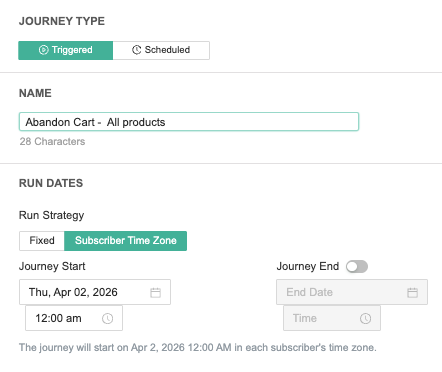
Customer journeys have become a central part of how marketing teams think about engagement. They promise structure, automation, and a clear path from first interaction to long term retention.
But despite the investment, many journeys underperform.
Not because teams are building the wrong flows, but because the systems behind those flows are not designed for how users actually behave.
The Flow First Trap
Most journey platforms are built around a structured approach. Teams map out steps, define triggers, and create sequences designed to guide users along a predetermined path.
This approach creates what can be called the Flow First Trap.
The focus shifts toward building complete journeys rather than improving performance. Teams spend time perfecting logic, adding conditions, and expanding flows, assuming that more structure will lead to better results.
In practice, the opposite often happens.
User behavior is not linear. People move between sessions, shift intent quickly, and engage in ways that are difficult to predict. When journeys are built around fixed sequences, they struggle to keep up with these patterns.
By the time optimization begins, the behavior the journey was designed for may have already changed.
Where Traditional Journeys Break Down
A simple example highlights the issue.
A publisher creates a re-engagement journey that triggers 24 hours after a user becomes inactive. The goal is to bring the user back after a period of inactivity.
However, the user returns just three hours later.
Because the journey is built on a fixed delay, no message is sent at the moment of return. The system waits until the 24 hour mark, when the user’s interest may have already faded.
This is how engagement is often lost.
Not because messaging is ineffective, but because timing is disconnected from actual behavior.
Many journey platforms rely on scheduled logic and historical data. While useful, this approach limits the ability to respond to real time intent.
What High-Performing Journeys Have in Common
The most effective journeys are not necessarily the most complex.
They are the most responsive.
They react to user behavior as it happens. They incorporate continuous testing. They prioritize relevance and timing over rigid sequencing.
Rather than functioning as static workflows, they operate more like adaptive systems powered by real-time engagement.
This shift is becoming increasingly important as user expectations and engagement patterns continue to evolve.
How Pushly Customer Journeys Take a Different Approach
Pushly Customer Journeys are designed with responsiveness at the core.
Instead of focusing on predefined paths, they are built to react to what users are doing in the moment. This allows teams to engage users when intent is highest, rather than relying solely on past behavior or scheduled triggers.
This approach changes how journeys are created, managed, and optimized over time.
Real-Time Behavioral Triggers
One of the key differences in Pushly Customer Journeys is the use of real-time behavioral triggers.
Journeys can activate based on live user actions, enabling immediate engagement when it matters most. A returning visitor can be reached as soon as they come back. A user showing high-intent can receive a message at the moment of consideration.
This reduces the delay between user intent and brand response, helping close a gap where engagement is often lost.
Continuous A/B Testing as a Core Capability
Testing is essential for improving performance, but in many platforms it is treated as a separate step.
Pushly integrates built in A/B testing directly into the journey framework. Teams can test variations in messaging, timing, segmentation, and trigger conditions without rebuilding their workflows.
This enables a more continuous optimization approach.
Instead of running occasional experiments, teams can iterate frequently and learn faster. Over time, these incremental improvements compound, leading to stronger overall performance.
Flexible Logic Without Added Complexity
Advanced journey logic often introduces operational challenges. As flows become more sophisticated, they can also become more difficult to manage.
Pushly addresses this by providing flexible logic that remains accessible.
Teams can create branching paths and conditional experiences while maintaining a streamlined workflow. This balance allows for both precision and speed, making it easier to adapt journeys as new insights emerge.
Why This Approach Is Difficult for Traditional Platforms
Many existing journey platforms were originally designed for campaign management rather than real-time engagement.
Their underlying architecture prioritizes control and scheduling, which can make rapid iteration and real-time responsiveness more difficult to achieve.
As a result, adapting to changing user behavior often requires additional effort, time, or complexity.
Pushly’s approach is built around real-time interaction from the start, which allows these capabilities to function more naturally within the platform.
From Campaigns to Ongoing Systems
A broader shift is taking place in how teams think about engagement.
Campaigns are inherently temporary. They are launched, measured, and eventually concluded.
Journeys, when designed effectively, can function as ongoing systems. They continuously respond to user behavior, incorporate new learnings, and improve over time.
Pushly Customer Journeys support this shift by enabling teams to move beyond one time campaigns and toward sustained engagement systems rooted in behavior-based messaging.
Conclusion
Customer journeys are evolving.
Static flows and delayed optimization are giving way to more adaptive, real-time approaches. Teams that embrace this shift are better positioned to meet users where they are and respond to changing behavior.
The advantage is no longer defined by how complex a journey is, but by how quickly it can adapt and improve.
Pushly Customer Journeys are designed to support that evolution, helping teams build engagement systems that keep pace with their audience. If you’re ready to build journeys that actually adapt to your audience, contact us and request a demo to see Pushly in action.